Seeing The Light – Our HAWK Signal Works!

By David Kosub (Contributor)

The HAWK signal at South Dakota Avenue and Ingraham Street NE is now operational! This is a wonderful step forward to strengthening pedestrian safety and encouraging walkability in Riggs Park.

I want to personally thank all the residents who devoted many person hours to ensuring we got to this point. You wrote letters of support. You spoke with the ANC. You reported many issues with 311. You worked behind the scenes with DDOT. Your dedication will not go unnoticed.  

DDOT was also a valued partner in this endeavor, and I want to recognize them too. They worked with us throughout the spring and summer, providing updates on their progress and hearing our multiple concerns.

If you encounter any issues with the signal, crosswalk, and/or drivers failing to stop, please contact 311 right away.

July 22: Gearin’ Up Bike Repair Pop Up at Lamond-Riggs Library

Gearin’ Up Bike Repair Pop Up
Lamond-Riggs Library
5401 South Dakota Avenue NE
July 22, 2019
5:00 pm

Need to dust off that bike sitting in the garage? Gotta fix that flat tire? Visit Gearin’ Up Bicycles at a neighborhood library near you to receive free basic bike repair and maintenance. Limit one adult bicycle or two children’s bicycles per customer. For a complete list of Gearin’ Up Bike Repair Pop Up dates and locations at DC Public Libraries click here

Events June 28 & 29, 2019

A few events to highlight this weekend

June 28, 2019

  • Fridays at Fort Totten Concert Series featuring music by Allthebestkids and Carnivore BBQ food truck. 6:00 pm, corner of South Dakota Avenue & Galloway Street NE. Bring a lawn chair for seating

June 29, 2019

  • DDOT Rock Creek East I Livability Pop-up: Share your views on how to make the transportation network safer and more accessible. Study area is defined by Rock Creek and the Maryland border to the West, Eastern Avenue to the North, New Hampshire Avenue NE and the Red Line Metrorail tracks to the East, and Military Road NW, Missouri Avenue NW, and Riggs Road NE to the South. 10:00 am-12:00 pm, Safeway, 6500 Piney Branch Road NW

Bus Bay Reassignment: Routes E2 and E4 at Fort Totten Station, June 23

For bus riders, from WMATA:

Bus Bay Reassignment: Routes E2 and E4 at Fort Totten Station, June 23

Advisory Effective: 6/22/19 – 7/31/19
Effective: Sunday, June 23, 2019

Routes Affected: E2, E4 

In response to customer requests, routes E2 and E4 will be assigned to new bus bays at Fort Totten Station beginning, Sunday, June 23. 

E2 Ivy City-Fort Totten southbound toward Ivy City 
E4 Military Road-Crosstown eastbound toward Riggs Park 
• Current Bus Bay Assignment: Bus Bay G – Stop ID 1003439 
• New Bus Bay Assignment: Bus Bay D – Stop ID 1003237

Decade: A Remembrance

By David Kosub (Contributor)

The following lines strive to remember where we were, how we felt, and what has happened since the Fort Totten metro train accident ten years ago. Though not meant as a singular story, this is more so a collective communal story woven together with memories shared from neighbors, news coverage, quotes from surviving family members, and a walk through Legacy Memorial Park.

June 22, 2009
Rush hour
Sitting on a red line train
Don’t remember how long it took me to get home
Don’t remember the alternate route I took
I do remember the delay
and wondering why is this happening
I just wanted to come home from work

When above ground and with access to the radio
I was  like, “Oh my”
That’s when I heard the commotion about the crash
And also Feeling selfish for those earlier thoughts

Curiosity leading me to the FIRE-EMS staging area
Realizing how bad the accident was
Just imagine being on the scene and imagine what you may have witnessed

Doolittle, DuBose, and Fernandez
Hawkins, King, and McMillan
Wherley, Wherley, and Williams
Nine lives lost
Many others injured

Looking back
Being grateful to be alive and prayerful for the victims
 “I miss my mom. I miss her laugh
“Cuz I’m [now] at a place of healing. A place of accepting”
“This is our national capitol, people should feel safe to get on metro”

Every day, we can commemorate this tragedy
Through a plaque on a metro station pillar  
We recognize “those whole lives that were forever changed”
And also understand what the first responders experienced
Coming to “our aid in our time of greatest need”

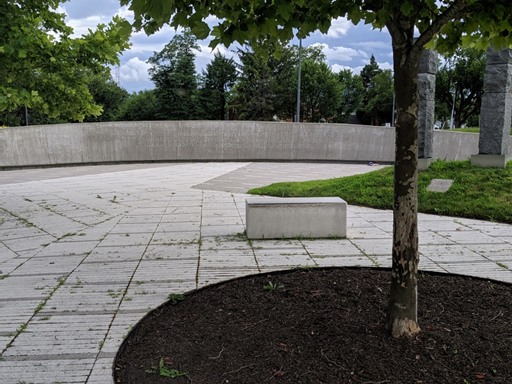
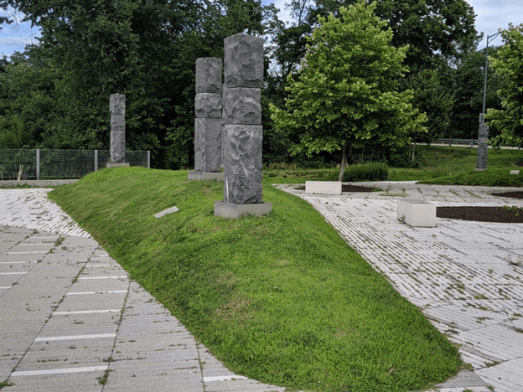
Through a nearby memorial park
While ringing with the sound of children playing
Mere steps from where a community grows together
We are also encouraged to meditate, remember, reflect, and hope

Words are found etched in stone
“The space inhabits the hearts of nine uncommon Souls.
They were put here to leave eternal love.
In stillness…embrace love, peace, courage, and strength.”

Legacy Memorial Park

Fort Totten Metro Ridership: By the Numbers

Guest post by David Kosub

After seeing the Riggs Park profile published by the Washington D.C.  Economic Partnership, the Fort Totten Metro Station data intrigued me. And, yes, before you ask, there is nothing wrong with being intrigued by looking at administrative data held within public agencies! All the cool kids do it.

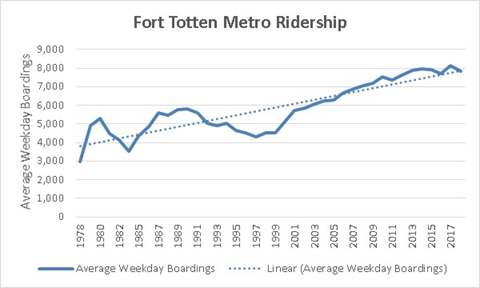
While searching the Public Records available on the Washington Metropolitan Area Transit Authority’s (WMATA’s) website, I did find a few nuggets of ridership data related to Fort Totten metro that I’d like to share (see the original source data here and my manipulations on this Excel sheet here). WMATA publishes historical ridership figures for each station going back to 1977, with Fort Totten coming online a year later (read these articles here and here to see how residents felt about it back then). Figure 1 displays the average number of weekday boardings per year at the Fort Totten station from 1978 to 2018 (data for 1983 were not available). Note, I assume “boardings” in Metro language refers to those who passed through a faregate, not simply transferred to another train (e.g., red line to green line). Boardings grew from 2,969 on an average weekday in 1978 to 7,842 four decades later. Note, these data represent actual average weekday boarding counts and not normalized to population change.

Figure 1 shows the average weekday boardings at the Fort Totten metro station between 1978 and 2018.

For kicks, let’s take a look at how Fort Totten compared to other stations across the system for average weekday boardings in 2018.  As the table below shows, we clock in at number 25—not too shabby, especially when considering some of those other stations our weekday boarding numbers beat!

Station 2018***
1 Union Station 28,315
2 Metro Center 24,532
3 Gallery Pl-Chinatown 22,613
4 Farragut North 22,184
5 Farragut West 20,348
6 L’Enfant Plaza 20,240
7 Foggy Bottom-GWU 18,299
8 Dupont Circle 16,542
9 McPherson Square 13,889
10 Pentagon 13,667
11 Rosslyn 13,020
12 Pentagon City 12,311
13 Silver Spring 11,682
14 Shady Grove 11,139
15 Navy Yard-Ballpark 11,013
16 Crystal City 10,795
17 Columbia Heights 10,448
18 NoMa-Gallaudet U 9,346
19 Smithsonian 9,331
20 Ballston-MU  9,029
21 Bethesda 8,999
22 Vienna/Fairfax-GMU  8,970
23 Archives-Navy Memorial-Penn Quarter  8,226
24 Friendship Heights 7,900
25 Fort Totten (woot woot) 7,842
26 Wiehle-Reston East 7,785
27 Federal Triangle 7,576
28 Judiciary Square 7,475
29 King St-Old Town  7,131
30 Capitol South 7,003
31 Huntington 6,896
32 New Carrollton 6,584
33 Court House 6,420
34 Anacostia 6,305
35 Federal Center SW  6,014
36 Ronald Reagan Washington National Airport 5,964
37 Franconia-Springfield 5,940
38 Woodley Park-Zoo/Adams Morgan 5,913
39 Georgia Ave-Petworth  5,889
40 U St 5,637
41 Van Ness-UDC  5,476
42 Glenmont 5,475
43 Brookland-CUA 5,436
44 Rhode Island Ave-Brentwood  5,417
45 Greenbelt 5,350
46 Eastern Market 5,303
47 Tenleytown-AU 5,286
48 Branch Ave  5,263
49 Medical Center 5,181
50 Takoma 5,033
51 Grosvenor-Strathmore 4,995
52 Southern Avenue 4,744
53 Braddock Road 4,376
54 Clarendon 4,375
55 Shaw-Howard U  4,314
56 Suitland 4,290
57 Waterfront 4,271
58 Mt Vernon Sq 7th St-Convention Center  4,238
59 Largo Town Center 4,181
60 East Falls Church 4,023
61 Prince George’s Plaza  4,012
62 Twinbrook 3,807
63 Dunn Loring-Merrifield 3,789
64 Rockville 3,756
65 Virginia Square-GMU 3,728
66 Cleveland Park 3,657
67 College Park-U of Md 3,650
68 White Flint 3,506
69 Potomac Ave 3,494
70 Tysons Corner 3,480
71 Wheaton 3,468
72 West Hyattsville 3,184
73 Addison Road-Seat Pleasant  2,652
74 Benning Road 2,604
75 Van Dorn Street 2,576
76 West Falls Church-VT/UVA 2,544
77 Stadium-Armory 2,423
78 Naylor Road 2,283
79 Congress Heights 2,223
80 Minnesota Ave 2,149
81 Forest Glen 2,045
82 Eisenhower Avenue 1,919
83 Capitol Heights 1,864
84 McLean 1,830
85 Morgan Boulevard 1,826
86 Landover 1,543
87 Arlington Cemetery 1,485
88 Greensboro 1,265
89 Deanwood 1,240
90 Spring Hill 1,203
91 Cheverly 980

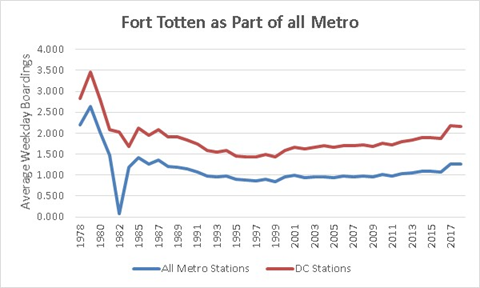
I next wondered how much of the total Metro daily boardings Fort Totten represented. To answer this, I looked at the proportion of Fort Totten boardings on an average weekday compared to (1) the system as a whole or (2) only those stations in the District. Please keep in mind that not every metro station open today (n=91) was around at the beginning (n=24), so ridership data can change substantively with each new station opening (amongst other factors).

Figure 2 displays these results. As a percentage of all of the stations in the system (lower line), Fort Totten started around 2.2 percent of all Metro boardings in 1978, fell to below 1 percent between 1992 and 2010, and began climbing thereafter rising to 1.3 percent in 2018.  When focusing on only stations in the District (higher line), the trends are the same, starting at 2.8 percent in 1978, dipping down in the 1990s and 2000s, and rebounding thereafter to 2.3 percent in 2018. 

Figure 2 shows the percent of average weekday boardings at the Fort Totten metro station compared to boardings across all metro stations (lower line) and metro stations in the District (higher line) between 1978 and 2018

So, what do these limited data tell us? Well, we can see the growth over time in the number of riders beginning their trips at Fort Totten on an average weekday. And, that is likely commensurate with multiple factors, such as changes and growth in D.C.’s population over time and more residents preferring public transportation to personal vehicles. Further, as compared to the system as a whole, it is exciting to see our numbers creep up in recent years, even when considering how many stations are open now compared to in 1978. To me, this shows a healthy use of the Fort Totten metro station on a daily basis—providing additional evidence that the nearby vicinity is ripe for robust transit-oriented development as called for in the 2009 Small Area Plan. My hope is that, when recruiting shops, restaurants, and other potential business owners to the neighborhood, we can use the additional evidence that our community is worth the investment.

Metro service proposal – ANC 4B resolution

h/t Gavin Baker

ANC Commissioner Evan Yeats (4B01) plans to offer a resolution in support of extending Metro service on the Yellow and Red Lines. Metro’s proposal was previously covered in this post. The draft resolution is here.

Metro’s Finance Committee approved the proposal on March 14, 2019, and the full board is scheduled to vote on March 28:

More Metro service could come to Fort Totten

Guest post by Gavin Baker

More trains could soon serve Fort Totten metro station, if approved by the Metro board.

In October 2018, Metro’s General Manager released the proposed budget for fiscal year 2020, which includes service improvements. The Washington Metropolitan Area Transit Authority (WMATA) board is expected to approve a final budget within the next few weeks. WMATA’s Finance and Capital Committee is scheduled to consider the budget proposal on March 14.

The proposed budget would benefit Fort Totten by adding Yellow Line service during rush hour and increasing direct connections on the Yellow and Red Lines.

Currently, Yellow Line trains end at Mt. Vernon Square during rush hours and at Fort Totten at all other times. Under the proposed budget, all Yellow Line trains instead would run to Greenbelt – to and through Fort Totten.

From 2012 to 2017, Yellow Line trains ran to Greenbelt under Metro’s “Rush Plus” program. The FY 2020 budget proposal would restore that service at all times.

For Fort Totten, the proposed budget would add new service during rush hour to downtown DC, Arlington, and Alexandria (toward Huntington) and to Prince George’s County (toward Greenbelt). Outside of rush hour, there would be additional trains toward Greenbelt.

The proposal would also add more direct connections on the Red Line. Currently, some Red Line trains turn back at Silver Spring. Under the proposed budget, all Red Line trains instead would run to Glenmont, providing more trains from Fort Totten to Forest Glen, Wheaton, and Glenmont.

WMATA estimates these changes would benefit 12.4 million Yellow Line and 3.4 million Red Line trips overall next year.

For now, this is only a proposal. The WMATA board has to give final approval, and board members have criticized some aspects of the proposed budget. However, the Yellow and Red Line changes seem to have broad support among the board, according to the latest reports. If approved, these service improvements could be significant for our neighborhood, and not only in terms of more convenient transit service. In addition to adding more service generally, it would also offer a one-seat ride from Fort Totten to the future Amazon “HQ2” in Arlington and Alexandria. Amazon’s expected 25,000 jobs in Northern Virginia will make it the largest private employer in the DC area, and those employees will have to live somewhere. With direct Yellow Line service from Fort Totten to “National Landing,” maybe some of them will choose to call Riggs Park home – or at least check out Meow Wolf.

Fort Totten needs better bike access

Guest post by Gavin Baker

Thanks to the 58 neighbors and bicyclists who responded to my survey between February 5 and 19, we now have more information about why and how to make the Fort Totten Metro station and the future Metropolitan Branch Trail more accessible to folks on bikes.

From the south: Galloway Street

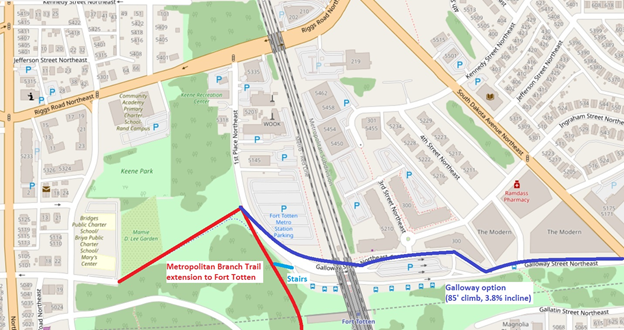
Galloway Street is one of the most important access routes for bicyclists to Fort Totten Metro station and the future MBT trailhead, but also the route most in need of improvements, according to the survey results.

Galloway Street option

Galloway Street was the:

  • Most preferred route if bike facilities were installed (51.8%, more than double the second-most preferred option);
  • Least preferred route under current conditions (26.8%); and had the
  • Lowest percentage of respondents who would be comfortable biking the route without new facilities (15.1%).

Several respondents identified the heavy vehicular traffic, the climb, or the combination of both as challenges with biking on Galloway:

  • “I live at the Modern so I bike the hill up Galloway frequently. It is packed with cars especially during the morning rush hour so getting up the hill and under the tracks is very tricky on a bike. Usually I either have to wait in line with the cars, or resort to the sidewalk. It’s not fun.”
  • “I bike from my home on Hamilton St NE to Ft Totten metro station. That hill is really tough, and is often a deterrent for me to bike.”
  • “I bike it now and it sucks. I’ll still keep biking it, but it feels very unsafe at rush hour with buses coming up Galloway, delivery trucks idling outside the Modern, and commuter cars in a rush to drop people off.”

My recommendation: Separate bike facilities should be installed on Galloway. While only 15.1% of respondents would be comfortable biking the route today, 71.7% would be comfortable if bike lanes were installed.

While the survey did not ask about an off-street trail along Galloway, it would likely serve the same need as an on-street bike lane, and probably even better. The District Department of Transportation’s (DDOT) 2014 moveDC plan includes a future trail along Galloway St. from the Fort Totten trailhead to South Dakota Avenue. Reportedly, DDOT is looking at options to make that happen. A trail alongside Galloway would not only significantly ease access to the Metro and MBT, it would also link to the future trail between Galloway and Gallatin Streets and the planned MBT segment continuing east to the planned Prince George’s County Connector.

From the north: Kennedy Street (or…)

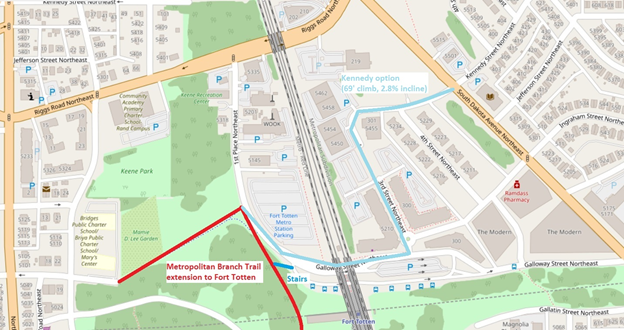
Access routes north of Galloway Street are also important, according to the survey results, with a slight preference for Kennedy Street over Ingraham Street.

Kennedy Street option

Kennedy Street was the:

  • Most preferred route under current conditions (39.3%); had the
  • Highest percentage of respondents who would be comfortable biking the route without new facilities (34%); and would be the
  • Second-most preferred route if bike facilities were installed (25%), after Galloway Street

Ingraham Street was slightly behind Kennedy Street on all counts, with responses rating it in between Galloway and Kennedy.

Some respondents commented that the Kennedy route is too roundabout or too far out of their way, especially those coming from the south (Galloway to Kennedy is an additional quarter-mile up South Dakota Avenue). However, a few respondents indicated that they use Kennedy currently and prefer that route:

  • “I’ve ridden Kennedy and 3rd to reach Fort Totten from Lamond-Riggs, and much prefer it to Galloway, even as is.”
  • “This is the way I usually now access the Metro station on my bike. The incline is more spread out with a break between Kennedy and Galloway. The same issue applies, though, with traffic back ups at underpass and traffic circle.”
  • “This is the way that I currently ride from my house (near Riggs and Eastern) to get across to NW. The ramp would be important, also the connection to the trail from the dead in at Kennedy St would need to be improved, it is always a big puddle and is getting worse. Also some lights on the trail would be a big safety improvement.”

My recommendation: Bicyclists should consider both Kennedy and Ingraham streets as potential options to access the Metro and MBT. Minor improvements could improve access, most importantly installing a curb ramp where 3rd Street ends and the asphalt trail begins. Signage could also be helpful. At the asphalt trail, drainage and security (lighting and visibility) should be addressed. Street adjustments to better accommodate bicyclists should be considered (such as a bike lane on Kennedy, traffic calming, and reduced speed limits).

Farther north

While this survey focused on the area between Kennedy and Galloway, access from farther north will also be an issue. Riggs Road, South Dakota Avenue, and the WMATA/CSX railroad tracks form considerable barriers for bicyclists.


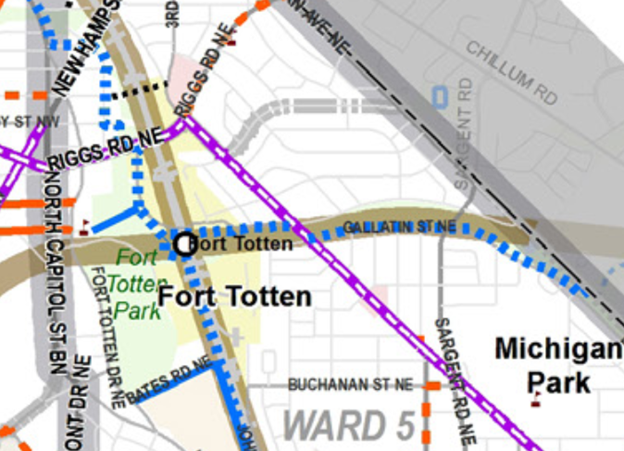
2014 moveDC plan. Blue dotted lines indicate a planned off-street trail, purple dashed lines indicate a planned cycletrack (or protected bike lane), orange dotted lines indicate a planned on-street bike lane, black dotted lines indicated a planned new street

DDOT’s 2014 moveDC plan includes protected bike lanes along Riggs Road and South Dakota Avenue, and in fact, one respondent indicated their preferred route with new bike facilities would be Riggs Road. But I don’t know if any progress has been made on those proposals. Additionally, the moveDC plan includes a new railroad crossing near Longfellow Street NE, which would connect to a future segment of the MBT. Those are improvements that would benefit our neighbors farther north in Lamond-Riggs and Manor Park, but their path forward is unclear.

HAWK Signal to Be Installed at South Dakota Avenue & Ingraham Street NE

Guest Post by David Kosub

In case you were not able to make the Lamond-Riggs Citizens Association meeting on February 4, DDOT announced they will install a HAWK signal, a controlled pedestrian signal, at the intersection of Ingraham St NE and South Dakota Ave NE. This is a great step forward in strengthening pedestrian safety here in our community.

DDOT has a handy video explaining how HAWK pedestrian signals work on its website. When a HAWK signal is activated by a push button, yellow lights will flash to warn motorists to slow down for an impending red light. When the light turns red, motorists will be required to stop, just as with traditional traffic signals, to permit pedestrians to cross the street.

Work is expected to be completed around late summer/early fall 2019. We will provide regular updates on DDOT progress as they are received over the coming months.

DDOT committed to take the following actions:

South Dakota Avenue NE and Ingraham Street NE Intersection

  •  Install a HAWK signal in accordance with the MUTCD and DDOT guidelines.

South Dakota Avenue NE and Jefferson Street NE Intersection

  • Install in-street pedestrian crossing signs (R1-6a) at both sides of crosswalk located at the southbound approach of South Dakota Avenue NE. 
  • Install advanced pedestrian crossing sign (W11-2) along both directions of South Dakota Avenue NE.
  • Remove the pedestrian warning sign on the northwest of Jefferson Street.

Mid-block (between Ingraham Street and Jefferson Street)

  • Update redundant parking regulation signs on the eastern side of South Dakota Avenue NE.

Please pat yourself on the back for this outcome. Without your letters of support, many reports to 311 and 911, outreach to elected officials, submitting traffic studies, direct engagement with city agencies, and so much more, we may not be in the position we are today.

The Met Branch Trail is coming to Fort Totten. Now, how will we get there?

Guest post by Gavin Baker

Take my survey to tell me what you think, or read on for more information.

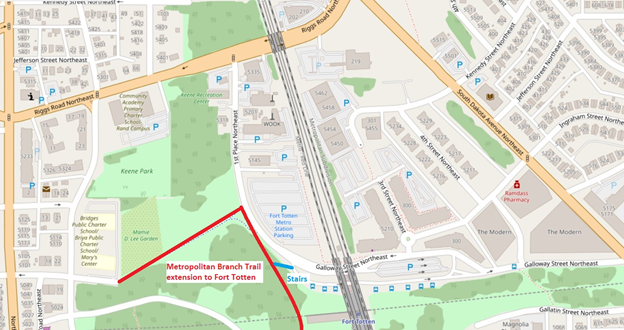
The Metropolitan Branch Trail (MBT) is a multi-use trail that will run from Silver Spring to Union Station when completed. Today, the trail segment connecting Fort Totten to the south is under construction and expected to open in 2020. When it opens, Lamond-Riggs and adjacent neighborhoods will have access to a great facility for walking, jogging, and biking. To access the MBT, the Fort Totten trailhead will be located on 1st Place NE, just west of the Fort Totten Metro station. The trailhead will connect to the sidewalk network, as well as the trail spur that connects west to Gallatin Street NE (which will be repaved as part of this project).

Overview map of the area, including approximate location of the new trail

But for those of us who live in Lamond-Riggs, the question is: How are you going to bike there?

Bicycling is one of the primary purposes of the MBT, whether for recreation or commuting. However, Lamond-Riggs currently has no bike facilities, other than a single bike lane on Kansas Avenue, a mile away from Fort Totten. (Michigan Park and North Michigan Park also have no bike facilities.)

Biking on sidewalks is legal in this area, but not recommended. (Bicyclists on sidewalks have to yield to pedestrians, and are at greater risk of being struck by drivers at road crossings.)

Since there are no bike facilities and we don’t want to bike on the sidewalk, then that leaves biking in the street. Four streets provide access to the Fort Totten trailhead from Lamond-Riggs: Riggs Road, Galloway Street, Ingraham Street, or Kennedy Street (via 3rd Street). Riggs Road is a difficult option for cyclists because of high traffic speeds and volumes, so let’s look at the others. Galloway, Ingraham, and Kennedy streets all share another challenge for bicycling: a big hill. The climb on Galloway Street from South Dakota Avenue to the Fort Totten trailhead is comparable to Meridian Hill! I’ve watched many bicyclists humping up that hill, and none looked like they were having fun.

Up a big hill

Route

Distance

Climb

Incline

Galloway Street NE from South Dakota Avenue to the Fort Totten trailhead

2,255′

85′

3.8%

16th Street NW from U St. to Euclid St. (Meridian Hill)

2,284′

85′

3.7%

(Data from Google Maps)

Of course, that hill is exactly why Fort Totten is where it is: to have a commanding view of Confederate advances. While that topography served the Union Army well, it’s not so great for a leisurely ride.

Combine topography with traffic and this will be a frustrating spot. Drivers don’t want to be behind an exhausted bicyclist going uphill . . . and that bicyclist doesn’t want to be in front of drivers. Notably, Galloway Street is the route for several Metrobuses, as well as parking and kiss-and-ride for the Fort Totten Metro station.

The MBT is meant to be enjoyed by people of all ages and ability levels. But under the current conditions, reaching the MBT by bike from Lamond-Riggs may be an unpleasant experience for many people.

However, there may be opportunities to make some improvements so our neighborhood can have better access. There have been various plans for bike facilities on or next to Galloway Street. The District Department of Transportation’s (DDOT) 2014 moveDC plan includes a future trail along Galloway St. from the Fort Totten trailhead to South Dakota Avenue. That trail segment would continue along Gallatin St. to the District line, to a connection with the Northwest Branch Trail in Maryland. If built, that segment would connect our neighborhoods to many more miles of trails. However, at this time there seems to be no concrete plan for building it.

2014 moveDC plan. Blue dotted lines indicate a planned trail

More modestly, last year DDOT listed a climbing lane as a “possible 2018 installation” on the lower portion of Galloway Street, from South Dakota Avenue to 4th St. NE (the alley through the Modern). A climbing lane is an on-street bike lane in the uphill direction only. While that would be a start, bicyclists would still have to mix with vehicular traffic the rest of the way uphill, and all the way downhill from the trailhead. More to the point, 2018 is now over and it didn’t happen yet. (However, the recent February Lamond-Riggs Citizens Association, a DDOT representative said that the planned sidewalk would be installed on the south side of Galloway Street in this location some time in 2019. Maybe the sidewalk and the bike facility are related?)

Looking north, the Cafritz Foundation’s Art Place development sits between Ingraham and Kennedy streets. Maybe new bike facilities could be built as part of any transportation changes arising from that development. In fact, the developers have stated that they would like to realign Kennedy Street in a future development phase. Realignment would involve new paving and curbs: if appropriate, maybe new bike facilities could be included.

These are some of the issues and ideas as I see them. How about you? Take my survey to tell me what you think, and let’s work together to find solutions for our neighborhood. If folks respond to the survey, I’ll share the responses out with the community.

February 6: Rock Creek East I Livability Study

Riggs Park is just outside the study area, but Lamond is included. The study area is defined by Rock Creek and the Maryland border to the West, Eastern Avenue to the North, New Hampshire Avenue NE and the Red Line Metrorail tracks to the East, and Military Road NW, Missouri Avenue NW, and Riggs Road NE to the South.

The District Department of Transportation (DDOT) will host its first public event for the Rock Creek East I Livability Study on Wednesday, February 6, 2019, from 6:30 pm to 8:30 pm. The purpose of this neighborhood study is to identify opportunities to enhance community quality of life through transportation safety and access improvements for all modes within the study area. At the first public event, DDOT will introduce the project, share data collection, and provide opportunities for participants to share existing concerns.

When:  Wednesday, February 6, 2019, 6:30pm – 8:30pm

Where: Juanita E. Thornton/Shepherd Park Neighborhood Library
7420 Georgia Ave. NW (SPK Meeting Room 2)
Washington, DC 20012

Project Background
DDOT is undertaking the Rock Creek East I Livability Study to evaluate the transportation network in the study area from a system perspective, and look for opportunities for a safer and more accessible multimodal network. This study will be led with a data-driven approach, using existing and future conditions to understand transportation challenges and opportunities and to recommend specific implementable actions. The study will be supported with robust public outreach throughout the process. You can find out more about the study by visiting www.rceast1.com.

Questions?

Contact the DDOT Project Manager: Cynthia Lin, cynthia.lin@dc.gov, (202) 671-2381

Community Letters of Support for Enhanced Pedestrian Safety along the South Dakota Avenue NE Corridor

Guest post by David Kosub

In no particular order, these letters of support come voluntarily from members of the Riggs Park community. Their goal is encouraging Advisory Neighborhood Commission (ANC) 5A to endorse a resolution requesting the District Department of Transportation (DDOT) to strengthen pedestrian safety crossing South Dakota Avenue NE.

As some requested anonymity, I decided to respect everybody’s privacy and remove all names and other identifying information from this public post. That said, their words still demonstrate passion. Concerns are vividly expressed. Personal experiences are relived. Actions taken are retold. And, most importantly, you will see how much they care for their community.

A resolution and our concerns will be presented at the January 30, 2019, ANC 5A meeting at 6:45 p.m. at UDC-CC Backus, so please attend if your schedule permits. If you would like your voice included as part of this initiative, please add your thoughts in the Comments section below.

———————–
Letter #1

I  am writing to voice support for the resolution brought forth by David Kosub. My husband and I moved to the neighborhood two years ago and began voicing concerns related to pedestrian safety and well-being crossing South Dakota Avenue NE at Ingraham Street NE and Jefferson Street NE (right by our public library) since that time.

We have collectively submitted dozens of 311 requests asking for improvements to safety in that area – ranging from white striping to signage to HAWK lights and even a traffic light. Each request is dutifully closed without any action taken. MPD officers themselves speed down South Dakota Avenue and do not stop at crosswalks. I’ve witnessed it many times. Every single time you cross, you literally take your life into your hands.

These two crosswalks are our main method of walking to and from the Metro Transit station each day. And it’s not just ours – it’s the pathway taken by nearly anyone in the neighborhood who travels via Metro – including young children, senior residents, families and even individuals who have disabilities or impairments. We’ve witnessed accidents (including a young pedestrian getting hit) which we’ve reported and near accidents personally. Better signage is seen throughout the South Dakota Avenue corridor and it’s incomprehensible at how much push back and delays we have faced to get the same signage installed at those two crossings.

As mentioned in the draft resolution, such concerns are likely to amplify as more residents move into nearby apartment buildings, development continues, commercial retail opens, Main Street aesthetic improvements are made, our local branch library reconstruction ramps up, and more citizens are encouraged to walk throughout the neighborhood (and/or come to visit the neighborhood).

The lack of safety precautions and appropriate lighting make this intersection deadly and it should not take a death for DC departments including the Mayors office, DDOT and MPD to work together to fix this problem. But from this lack of action and collaboration it feels as if that’s what these departments are waiting for. This lack of action is terrible customer service and very inconsistent with DC’s Vision Zero goals. I know that District officials can do better and offer a better response than what has been provided thus far. We’ve been waiting nearly two years and that’s long enough – I urge you to take action now.

———————–
Letter #2

I am very familiar with the situation at South Dakota and Ingraham. I walk to Metro every weekday from my house on Kennedy St., crossing South Dakota Avenue at the area under discussion. I walk back each weekday evening. As I have watched the Modern arise over the past few years, I have often wondered why the traffic signal remained at Hamilton and was not relocated to Ingraham.

From my personal experience, I do not have a problem crossing South Dakota in the morning. It is light out and there is often a substantial break in traffic to cross safely. Cars often slow down or stop for me. However, coming home in the evening is different. Northbound traffic seems to move much faster than the 25-mph limit. (I suppose people want to get home.) I also feel that I am not well seen in the evening.

I urge DDOT to reopen their exploration of this series of intersections and attempt to make it safer before something bad happens to a pedestrian.

———————–
Letter #3

We’re new homeowners in Lamond-Riggs, and proximity to metro and walkability were priorities when considering where to live. While we love being within walking distance of the Fort Totten metro, we’ve been dismayed at how dangerous it is to cross South Dakota Avenue to get to and from work each day.

Cars treat the stretch of South Dakota between Gallatin Street and Riggs Road like a raceway, and we sometimes have to step into traffic and wildly wave our arms at oncoming traffic in order to get them to stop. We’ve seen older residents stuck on the corner waiting for a break in traffic; cars that speed up because they’re coming off the light, even as people are already in the crosswalk; and drivers mockingly waving at people in the crosswalk as they speed through. It’s only a matter of time before someone is seriously hurt.

At a recent meeting with a DDOT representative, we were upset to hear that they did not know how long it would take to get signage at the intersection of South Dakota and Ingraham Street — the main access point to metro — and that there was no plan by DDOT to deploy the kind of infrastructure we’ve seen in other neighborhoods (traffic calming measures, flashing lights, or a traffic light, for instance).

If the city is serious about redeveloping Fort Totten, it must prioritize pedestrian access and safety, especially along such a primary access point to metro across a busy road.

———————–
Letter #4

I am writing this letter to express my strong support of efforts to increase pedestrian safety at the intersections of South Dakota Avenue and Jefferson Street NE and of South Dakota Avenue and Ingraham Street NE. I moved to Jefferson Street NE in September 2018 with my husband, and I use the crosswalk at South Dakota and Jefferson every weekday morning and evening to get to and from Ft. Totten Metro Station.

My experience with the crosswalk at Jefferson has been frustrating and frightening, because the vast, vast majority of drivers ignore pedestrian right of way at these intersections-even when I’m in the middle of a crosswalk. On average, I estimate that a vehicle only stops to let me start to cross the road once every 2 weeks. Every other time I’m at the intersection I have to wait for a break in traffic to be able to cross the street. I used to enter the crosswalk when the road was clear for the first section, so that I didn’t have to wait as long, but about once every week a driver would still drive through the crosswalk right in front of me without stopping. Earlier this month a driver doing this was also speeding, and I narrowly avoided him killing me.

Safe pedestrian access to the Metro station is too important to ignore. Please help.

———————–
Letter #5

I have lived on Ingraham Street NE for eight years and have observed one measure taken to address pedestrian safety since I have moved into the neighborhood – the addition of crosswalk painted lines to cross South Dakota Avenue. I walk and drive on South Dakota Avenue NE multiple times a day and worry about the safety of those crossing the street, particularly during rush hour and night times. That intersection is also not particularly well lit, making it difficult for drivers to see pedestrians waiting to cross.

As a frequent driver, I have noticed this firsthand – I will stop at the crosswalk to let a pedestrian cross only to have 10 cars drive past me instead of stopping.

Please help us keep my neighbors safe by installing additional pedestrian safety measures such as hawk lights and advanced pedestrian warning signs at this intersection.

———————–
Letter #6

I am writing to express my disappointment that the City has failed to properly ensure a safe street crossing at the intersection of South Dakota Ave. and Ingraham St. NE.

Our community is a diverse populous which includes many senior citizens, children, disabled citizens, and pets. All of us, but most particularly these residents, rely on quick and safe passage to the Fort Totten metro station. Many of these people can’t and shouldn’t have to divert their walking path due to the City’s failure to resolve a very dangerous crosswalk.

At this crosswalk, one of our neighborhood’s primary paths to Fort Totten metro station, cars often do not slow/stop for or even notice the pedestrians attempting to cross. I have experienced firsthand the dangers of crossing at this crosswalk. Luckily, I am able to divert my route to avoid this dangerous crossing because I do not have mobility issues.  Many of our neighbors do not have this luxury. If a solution is not rectified soon, I am afraid of a fatal accident involving one of our neighbors.

———————–
Letter #7

I am a resident of Riggs Park. I live on Ingraham St NE and I cross the crosswalk on Ingraham and South Dakota on my route to the metro every day for work.

I constantly struggle with crossing South Dakota because there is no enforcement for cars to stop for pedestrians. It is especially difficult during rush hour as there are more cars speeding down the road which usually takes me minutes to wait for cars and/or traffic to come to a halt. It is most concerning when I see kids and teens crossing the street going and coming from school.

Please help us find a solution to keep the residents of our neighborhood safe.

———————–
Letter #8

We are writing in support of increased pedestrian safety at Ingraham St. and South Dakota Ave. NE. We can attest, as Riggs Park residents, to the need for slower traffic patterns on South Dakota Avenue. Cars traveling on South Dakota frequently ignore pedestrians looking to cross the avenue on the way to the Fort Totten metro station. Additional traffic lights, cross walks, and other measures are necessary.

———————–
Letter #9

We are writing to express our concerns with the current state of the pedestrian crossings on South Dakota Avenue NE between Hamilton Street NE and Jefferson Street NE.  We purchased our home in June of 2016, while the Modern at Art Place was still under construction. We were hopeful that the pedestrian conditions on South Dakota Avenue would improve with the completion of the development, but it seems as though the opposite has happened.

The signalized intersection at Hamilton Street NE seems to give priority to the currently nearly non-existent traffic exiting from the parking garage over pedestrians, and the crosswalks at the intersections of Ingraham Street NE and Jefferson Street NE are poorly marked, poorly lit, and poorly signed. We have given up trying to cross at either Ingraham or Jefferson and walk out of our way to Hamilton or Gallatin on our way to Metro. Motorists often drive through the intersections at a high rate of speed, and even when they are driving the speed limit, they rarely stop for pedestrians at Ingraham and Jefferson as required by DC Law. This is obviously a dangerous situation for pedestrians in the Lamond-Riggs neighborhood who need to access Metro.

We encourage the ANC to work with DDOT to improve pedestrian safety on this stretch of South Dakota Avenue so that residents of the Lamond-Riggs neighborhood have a safe way to access the new retail at the Modern as well as the Metro.

———————–
Letter #10

I cross Riggs Rd. and South Dakota Ave. every day during my commute to and from work. I frequently cross at the intersection of Riggs and South Dakota.

This major intersection is dangerous. It is heavily trafficked during rush hour, and the turning patterns are not safe for pedestrians. I can only speak anecdotally, but as a 31-year-old man I have to think that if I don’t feel safe crossing, it must be much worse for slower walkers or those with a disability.

In the morning, people trying to turn from South Dakota onto Riggs frequently block the box and attempt to beat the light. The result is that, despite having a walk signal, pedestrians have to weave through cars, heavy trucks, and buses to try and cross in the short period of time allotted. Any delay, such as having to walk around a large vehicle, puts a pedestrian in danger of still being in the crosswalk when the light changes. Additionally, because cars are trying to beat the light, cars are regularly still turning through the crosswalk when the walk signal is illuminated.

In the evening, drivers barrel down the hill from Riggs and turn onto South Dakota. Vehicles often make this turn at speed, regardless of whether they have a green light. I have been almost hit several times by drivers making this turn despite having a walk signal.

I feel like the entire South Dakota corridor needs to be slowed and better tailored towards pedestrian safety. A red-light camera at Riggs and South Dakota would go a long way to slowing traffic down and prevent blocking the box, as would a prohibition of turning right on red.

When I speak to neighbors, I hear frequently of issues trying to cross South Dakota at various pints to get to the Fort Totten Metro Station.  As the area continues to develop and seek to attract more pedestrians as part of the Main Street program, I hope that attention is given, and planning made for this planned influx of people and their safety is prioritized.

———————–
Letter #11

I write this letter in support of a resolution by the ANC to request that DDOT take action to improve pedestrian safety along the South Dakota Avenue/Riggs Road NE corridor.

Specifically, I write in support of a request that DDOT:

  • Install a traffic signal at South Dakota and Ingraham Street NE. Ingraham Street serves as the through street for pedestrians to walk to Fort Totten metro
  • Install pedestrian crossing warning signs along the corridor, starting with but not limited to the intersections at South Dakota Avenue & Ingraham Street NE as well as South Dakota Avenue & Jefferson Street NE
  • Install permanent driver feedback signs in both directions on South Dakota Avenue approaching the South Dakota & Ingraham intersection

As a community leader, I have been working to address pedestrian safety issues along this corridor. I receive emails on this issue on a nearly weekly basis. Given the importance of pedestrian safety, I encourage the commission to request that DDOT act without delay. Mayor Bowser recently appointed a Vision Zero director within DDOT. It is past time for District officials to make real investments to achieve its Vision Zero goals instead of just offering platitudes.

———————–
Letter #12

I am writing in support that ANC 5A take up the resolution as presented by David Kosub to increase pedestrian safety along the South Dakota Ave/Riggs Road NE Corridor. I am most concerned about the intersection of South Dakota NE and Ingraham NE, which is the throughway to the metro train and numerous metro busses that serve the Lamond-Riggs and adjacent communities.

I have experienced numerous near-accidents from cars zooming down South Dakota, completely ignoring the marked pedestrian crossings at Ingraham St NE and Jefferson St. NE. Sometimes, motorists even angrily gesture at me for crossing the street at the legally marked crosswalks, and most do not stop or even slow down. When an attentive motorist does stop, those behind it tend to still ignore the pedestrian crossing and instead, go around the stopping car to pass through the crosswalk. It is scary, especially as a pregnant woman, that despite numerous alerts and requests from citizens about these dangers, that the City and DDOT do not follow through with securing these intersections. I worry about myself, my growing family, my elderly neighbors, children of all ages, and community members with disabilities (e.g. wheelchairs, walkers, and who are visually impaired).

A solution is possible – ideally a traffic signal or a HAWK signal with adequate lighting and signage – to contribute to keep our neighborhood safe for pedestrian’s and motorists alike, particularly as construction of the second phase of the Modern begins.

———————–
Letter #13 (Added 1/30/2019)

Currently the only intersection that has a pedestrian friendly walk signal to get to the Ft. Totten Metro station is at Hamilton Street NE. Before “THE MODERN” was completed, Hamilton Street NE was the through street to the Ft. Totten Station. Now, Hamilton Street ends at South Dakota Ave. and it is Ingraham Street at South Dakota Ave. that serves as a direct link to the station.

There is a need to have a pedestrian friendly signal to cross South Dakota Ave. at Ingraham Street N.E or at South Dakota Ave. and Jefferson St. NE.

We are personally affected or know someone who uses this route daily and would like to see the installation of some type of traffic signal or pedestrian friendly walk signal that would ensure the safety for all.

Signed by 26 community members of Jefferson St NE

———————–
Letter #14 (Added 1/30/2019)

I write to ask for your support for a traffic signal at the intersection of South Dakota Avenue and Ingraham Street Northeast and other pedestrian safety improvements on South Dakota in this area.

I walk through this area daily to and from the Fort Totten Metro station and I have felt concerned about my safety on several occasions. Guests visiting my house have also expressed difficulty crossing South Dakota here. Walking in our neighborhood should be safe for everyone, including our seniors, children, and people with disabilities. Installing a traffic signal at Ingraham Street is the best solution to provide safe crossing for our residents coming from Ingraham, Jefferson, and cross streets, including the Lamond-Riggs Library. Sadly, DDOT has not acted decisively when our neighborhood has raised these concerns in the past.

Our neighborhood deserves better. I urge the Commission to pass a resolution putting its weight behind our efforts to push DDOT to address this situation and keep our neighborhood safe.

———————–
Letter #15 (Added 2/4/2019)

As the Ward 5 representative on the D.C. Pedestrian Advisory Council, I write to express my concern about the conditions faced by pedestrians crossing South Dakota Avenue Northeast at Ingraham Street and Jefferson Street, and to request an urgent response to determine what infrastructure can be put in place to protect these residents as soon as possible.

Neighbors have recently reported several near-miss incidents where pedestrians were almost struck by drivers while crossing South Dakota Avenue at these intersections. This is unacceptable anywhere in the District of Columbia, but it is especially concerning for a primary pedestrian access route to the Fort Totten Metro station. No resident of the District should be forced to take their life into their hands in order to access public transportation.

I join with neighbors and ANC 5A in asking DDOT to promptly implement safety improvements that will reduce the risk to pedestrians from vehicular traffic at these crossings. I urge DDOT to perform a traffic count to determine whether a traffic signal or rapid flashing beacon can be installed at the intersection of South Dakota Avenue NE and Ingraham Street. Enhanced lighting and signage are needed to help improve the pedestrian experience at this location, and improvements to the roadway design are also needed to deter speeding and red light running in the vicinity. I urge DDOT not to remove the zebra stripes at the Jefferson Street crossing, which would add to the difficulty of crossing South Dakota Avenue, but to instead add sufficient measures such as curb extensions or a median island that would make crossing here safer.

Thank you for your prompt attention to this matter.

Mixed Signals

Guest post by David Kosub

From asking why we are here to wondering what exactly is in a hot dog, I enjoy thinking about life’s unsolved mysteries. This even goes for our local mysteries too—like why is there a traffic signal at Hamilton Street NE at South Dakota Avenue, but not at Ingraham Street.

This particular mystery originated when the Modern at Art Place, the first phase of the Art Place at Fort Totten development, opened in late 2017. Before construction on the project began, Hamilton was a through street to Fort Totten metro station for Riggs Park residents. This would change once construction on the Modern was completed. Now, Hamilton ends at South Dakota, while Ingraham serves as the new through street to the metro flanked by retail. Despite this change, the traffic signal remained at Hamilton.


The developer’s original traffic study for the project assumed the traffic signal would be at Ingraham, not Hamilton. After the project was initially approved, it appears from traffic study filings from the developer with the Zoning Commission in 2012 that DDOT instructed the developers to “modify” the signal at Hamilton in addition to installing a traffic signal at Ingraham. A 2014 brochure from the leasing agent reflected this understanding too.

Something must have changed after construction began in 2014; perhaps DDOT had further conversations with the developer and they changed their mind again about where to have a traffic signal. The developer did in fact keep and upgrade the traffic signal at Hamilton as requested by DDOT, but for whatever reason, a traffic signal has not been installed at Ingraham.

Though more information is needed regarding the placement of the existing signal, the most obvious pedestrian access point to the metro and retail remains unsignalized. So, why can’t a HAWK signal or other traffic safety measure at Ingraham Street and Jefferson Street be installed instead to increase pedestrian safety and well-being?

Residents have requested many pedestrian improvements going back to November 2017 related to these intersections (see timeline at the end of this post). At the community walk through in March 2018, DDOT informed neighbors the traffic study was nearly complete, that a HAWK signal would be installed at Ingraham, and that it would take six months to install. Spoiler alert, there is still no pedestrian signal today. Neighbors, despite many attempts, have not succeeded at understanding this DDOT decision.

So, I FOIA’ed them and here is what I found.

The Study (see DDOT provided documents here)


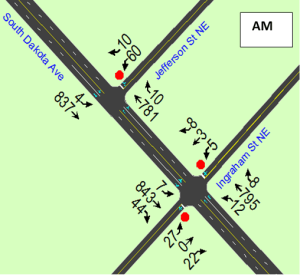
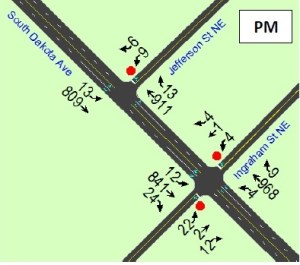
DDOT conducted a study per their standard 2009 manual practice in response to “perceived unsafe crosswalk conditions [including for the blind and elderly].” A “Professional Traffic Engineer” assessed vehicular and pedestrian volumes at “stop-controlled intersections” on Wednesday, December 6, 2017, during the peak hours of 8:00 am to 9:00 a.m. and 5:00 pm to 6:00 pm.

Ingraham Jefferson
Distance from Signalized Intersection 250 ft from Hamilton 275 ft from Kennedy
Vehicles 1700-1900 1700-1900
Pedestrians 43 28
Bicyclists 4 4
Vehicle-Vehicle Crashes (01/01/2013-12/31/2015) 3 3

In addition to the pedestrian, bicyclists, and vehicular counts, the report also noted the following items related to the intersections:

  • Posted speed limit was 25 Miles Per Hour
  • Adequate minimum vehicle stopping and intersection sight distances
  • Correct placement for existing signs and pavement markings, but no pedestrian warning signs at crosswalks
  • Observed pedestrians using crosswalks
  • Observed single drivers, but not those in “a platoon,” stopping for pedestrians

DDOT used a scoring matrix to evaluate the need for a HAWK signal. A simplified version is shown below with the score from their 2017 study (refer to the full report for explanation of the variables).

Variable Points Possible Points Awarded
Pedestrian and Bicycle crashes (over recent 3-year period) 20 0
Vehicle Crashes (over recent 3-year period) 10 6
Street Traffic Volume 30 30
Number of lanes at peak hour 30 10
Elderly and disabled population 10 0
Proximity to K-12 School 15 9
Connection to parks, rec center, commercial, etc. 15 15
Metro station / bus stop 20 0
Posted speed limit 15 5
Distance to nearest signalized intersection 30 0
Crosses bike path 5 0
Total 200 75

The Decision

According to their data, vehicular and pedestrian traffic counts warranted a HAWK signal at Ingraham street. But, as their report states, “satisfaction of meeting a warranting criteria shall not in  itself justify the installation of a new traffic signal. Rather multiple site-specific factors must be considered, and engineering judgment applied before justifying any change in traffic control.”

Though we received an overall failing grade, the report also recognized pedestrian volumes would likely increase when the retail at the Modern opens.

Here is my take

For starters, their study does not appear to be the most rigorously designed. From being conducted on a single day, for only two hours, by one person, likely with temperatures that discouraged walking, lack of good lighting, and the Modern apartments barely open with no retail at that time, it seems unlikely that accurate and usable data would be obtained as the basis to make a decision.

The proximity to two other signalized intersections (Kennedy and Hamilton) appear to be the biggest reason why a HAWK signal was denied. Generally speaking, DDOT discourages traffic signals from being placed within 300 feet of each other because “challenges [exist] with signal coordination, driver confusion and lack of vehicle queuing space.” Putting aside the fact that HAWK signals have been installed to “help pedestrians safely cross [other] high traffic volume streets” (I’m looking at your ”mid-block crosswalk” Cleveland Park), I do find it dismaying that they would cite “driver confusion” here when pedestrian safety is just as critical (see any recent editorials on Vision Zero). The truly funny thing is that if the traffic signal had been installed at Ingraham to begin with, instead of being kept at Hamilton, then that would actually be more than 300 feet from the lights at Kennedy and Galloway.

DDOT also cites the “adequate sight distance for pedestrian visibility,” lack of pedestrian involved traffic crashes, and that “gaps” in through traffic are created with the current signal timing plan as additional factors to not install a HAWK signal. However, anybody waiting to cross those intersections would likely attest to the inadequate visibility they feel as pedestrians, especially when attempting to navigate the gaps in the platoon of cars barreling down South Dakota Avenue.

Speaking facetiously of course, I guess we need to have more pedestrian-involved crashes first to have more points on the DDOT scoring matrix, which would then help justify our request for increased pedestrian safety. But seriously, we really should not be waiting until any other unfortunate tragedies such as this one occur before the city takes action to install pedestrian safety measures within 250 feet of another signal. When it comes to the lack of pedestrian and bicycle crash incidents from 2013-2015, the Ingraham intersection in question did not even exist. The apartment building was under construction most of that time and the new street did not exist. A more appropriate use of pedestrian safety data would be all the 311 submissions neighbors have made regarding near crashes and other concerns since this intersection has been accessible by foot.

Going back to DDOT’s scoring matrix, no points were given for the elderly and disabled populations, despite that being part of the premise for the study. The intersection’s proximity to the metro did not yield points either, even though Ingraham is the through street to the metro.

Finally, DDOT did not independently act on a list of additional recommendations that were made in the report. Instead, neighbors needed to make numerous 311 requests to prompt the pedestrian safety enhancements. Such requests ended up being similar to the report’s recommendations unbeknownst to us, such as increasing crosswalk monitoring and installing high visibility pavement markings for the Jefferson Street crosswalk.

What’s Next

This is not the end of the story. At both the December Lamond-Riggs Citizens Association meeting and the brainstorming session, DDOT agreed to perform another study to evaluate if a HAWK signal is warranted now. Let’s hope they work with the community to design the best study possible.

Please join us at the next Advisory Neighborhood Commission 5A meeting where the topic of increasing pedestrian safety crossing South Dakota Avenue will be discussed. A draft resolution will be presented to the Commissioners as well. The meeting will be Wednesday, January 30, 2019 at 6:45 p.m. at UDC-CC Backus. If you want to submit a letter of support regarding this issue, please email a 250-word statement here.

Riggs Road Bus Service Survey

Post updated with flyers and correction to Proposal 3

Metro Riggs Road Service Evaluation Study

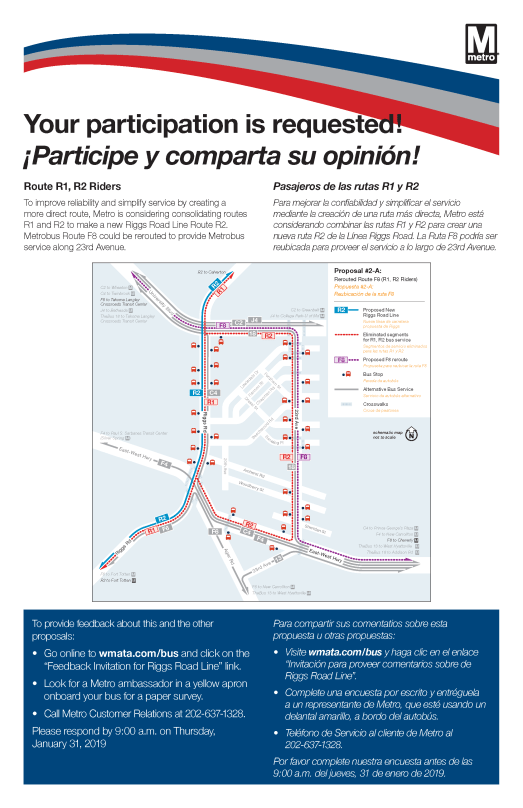
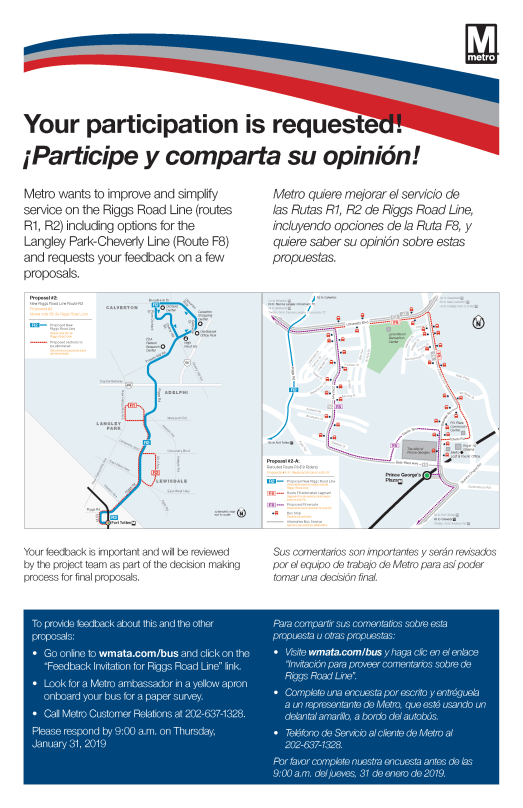
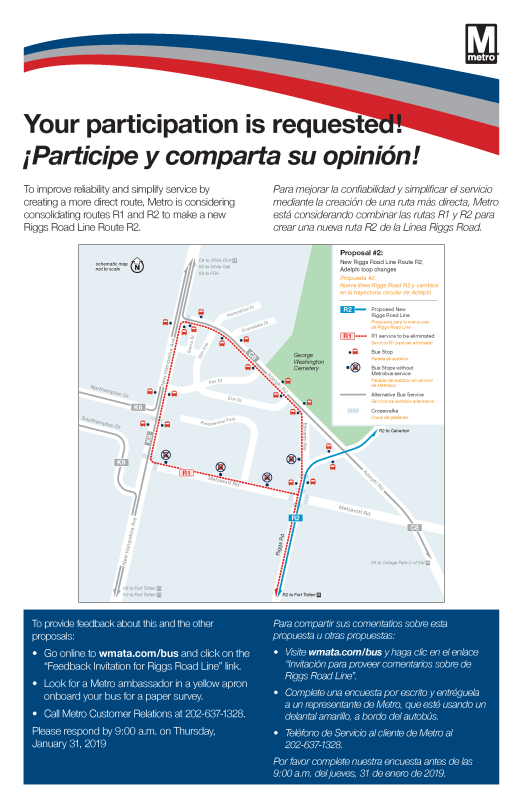
Metro is seeking input on proposals that will impact the Riggs Road Line (routes R1, R1). These proposals will impact service in the neighborhood.

Proposals:
1. Extend Route R2 beyond Calverton
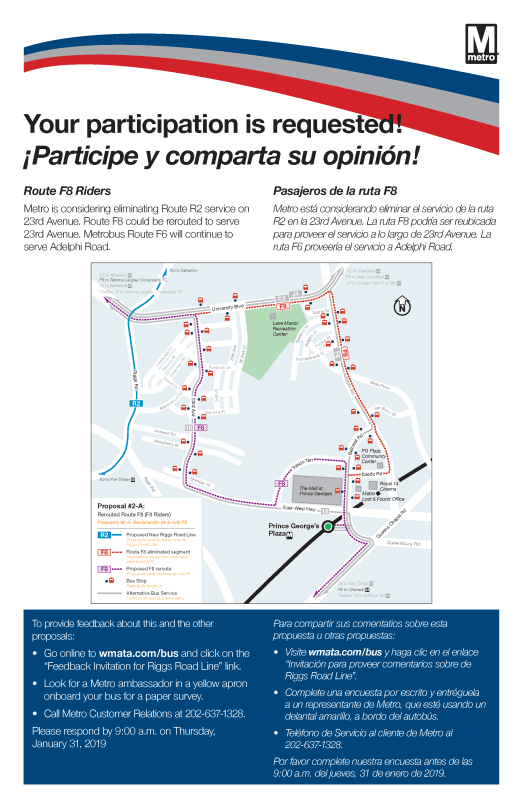
2. Consolidate Routes R1 & R2 to make a new R2 Line that will be more direct along Riggs Road; reroute F8 to serve areas that would be removed from the new R2 line, including parts of East-West Highway and University Boulevard
3. Consolidate bus stops on routes C4, C8, F8, R1, R2, & Z6 to remove stops that are not used frequently or that are close to other stops

How to provide feedback:

  • Take the online survey and provide comments
  • Complete a paper survey via a Metro ambassador in a yellow apron onboard your bus. Drop your completed survey at a collection box near the faregates at Fort Totten, Prince George’s Plaza, West Hyattsville or Cheverly Metrorail stations.
  • Call Metro Customer Relations at 202-637-1328.

Responses are due by 9:00 am on January 31, 2019

Actions from South Dakota Avenue Pedestrian Safety Community Brainstorming

Guest post by David Kosub

Dear Neighbors,

Thank you to all who participated in Wednesday’s Community Brainstorming session (in person or via email) to address pedestrian safety crossing South Dakota Avenue NE at Ingraham Street and Jefferson Street. Please find below the results from that meeting with specific actions we can take as a community to address this issue. Please share widely. These steps will also be shared with MPD and Cafritz Foundation representatives.

South Dakota Pedestrian Safety Community Brainstorming Session

Wednesday, December 12, 2018

Lamond-Riggs Library

Purpose: To hear from community members about concerns crossing South Dakota Ave at Ingraham St NE and Jefferson St NE intersections, as well as to identify possible solutions to increase pedestrian safety.

Attendees: ~10 Community members, DDOT (Wesley Dawson), MPD, Cafritz Foundation, and Mayor’s Office (Julia Irving). Councilmember McDuffie’s Office and ANC Commissioners were invited but did not attend. .

General Concerns from the Community

  • The Ingraham and Jefferson Streets NE intersections are a public health and safety issue, with community members reporting near-accidents from speeding cars not willing or able to stop (perhaps due to visibility issues). The community should not fear crossing the street, especially while going to the metro.
  • Vehicular traffic (including MPD patrol cars) regularly fail to stop for pedestrians at either intersection. Concerns about 8th and 10th St. NE intersections were raised as well.
  • There is a lack of adequate (or any) signage on South Dakota NE for pedestrian crossings.
  • It is unclear why the most appropriate path to the Fort Totten metro station at South Dakota and Ingraham Streets NE is not signalized already as part of the original plan to create a new through-way to the metro when Hamilton St NE, which previously served as a direct route to the metro station, was permanently closed by the Art Place at Fort Totten project.
  • 311 operators have misinterpreted pedestrian safety concerns related to aggressive driving when attempting to cross these intersections as 911 issues
  • Community members report being anxious that the issue will go unaddressed and become worse due to inaction from DDOT and Mayor’s Office (clear failure in achieving Vision Zero goals to avoid pedestrian injuries and fatalities) and with new construction projects scheduled.

Recommendations from Community Members (received during session and via email)

Actions to Take Immediately

  • Regularly and frequently submit 311 requests to improve pedestrian safety.
  • Request speed cameras per guidance on the MPD website. (Request link (updated 12/17/2018) – or contact MPD 4D community liaison)
  • Encourage MPD patrol cars to make audible noises and immediately stop traffic when pedestrians are seen waiting in intersections
  • Contact elected officials (Councilmember McDuffie’s OfficeANC commissioners Frank Wilds and Gordon FletcherMayor Bowser, and Mayor’s Office of Community Relations and Services) demanding this issue be addressed ASAP.
  • Request DDOT share all publicly available information on initial HAWK traffic/pedestrian study.
  • Contact local media to raise public awareness.
  • Request DDOT to place driver speed feedback signs on South Dakota Ave.
  • Request wider, perhaps artistic crosswalks similar to crosswalks at Georgia and New Hampshire NW or on Kennedy Street NW, so that these crosswalks are even more noticeable to drivers (added 12/17/2018)

 Actions Beginning in February 2019

  • Request MPD increase the number of cars patrolling intersections.
  • DDOT install static signage (including Pedestrian Crossing, Yield, Radar announcements, etc.) for pedestrian crossings with red flashing lights.
    • Note: DDOT representative indicated that signs were ordered and will look into expediting installation (within 30-45 days of order). DDOT will determine if infrastructure exists to operate flashing lights.
  • DDOT will begin new study for HAWK Beacon signal (see section below).

 Actions over Next Year

  • DDOT should either move signalized intersection from Hamilton St NE to Ingraham St NE or put new signal at Ingraham.
  • DDOT should improve lighting on entire South Dakota NE Corridor from Riggs Road NE to Galloway St NE, particularly at intersections so that drivers can see pedestrians waiting to use crosswalks.
  • DDOT should investigate the timing of signalization lights along South Dakota NE and at Kennedy St NE (apply lessons learned from the street light modernization project). The green cycle is very long, the yellow light seems long, and both of those could be encouraging drivers to speed down South Dakota and not stop for pedestrians at Ingraham.

 Actions that Cannot be Implemented

  • CM McDuffie Constituent Services Director Kelley Cislo forwarded a recommendation from MPD to have crossing guards at Ingraham St. NE intersection during morning and afternoon rush – Mr. Dawson said Traffic Control Officers (i.e. crossing guards) are only stationed near schools.
  • Install physical impediments (e.g. raised crosswalks) to slow vehicles on South Dakota – DDOT indicated “upward deflections” are not allowed on major arterials.

Considerations from Other Stakeholders

District Department of Transportation (DDOT)

  • Acknowledges community concerns and takes pedestrian safety seriously.
  • Reminds community that South Dakota NE is a major roadway (i.e. arterial road) in and out of the city. DC does not permit traffic calming measures on arterial roads.
  • HAWK (High-Intensity Activated crosswalk) Beacon Signal Study
    • Previous DDOT study counted only 20 pedestrians crossing South Dakota NE at Ingraham St NE (i.e. it did not meet threshold for HAWK installation).
    • Unclear how rigorous the study protocol was to make an informed decision from data acquired. When conducted in January 2018, the Modern Apartments were not yet fully open, commercial retail not in place, high-visibility (zebra) striping at roadway was not yet completed, and the lighting was minimal.
    • DDOT will study both Ingraham and Jefferson intersections, but will likely prioritize Ingraham; DDOT will follow up on timeline
  • DDOT can install flex posts in roadway (but they are regularly knocked down by cars).

Metropolitan Police Department (MPD)

  • Reiterated that only two or three officers are available for traffic issues in 4th District.
  • Shares community complaints to officers.
  • Cannot have officers dedicated to specific streets 24/7 (lack of resources) and recognize that pedestrian safety/vehicular traffic are commonly cited concerns across the city.

Cafritz Foundation – Art Place Phase 1 and 2 projects

  • Favors safer pedestrian crossings at these intersections and supportive of solutions, specifically supporting the idea of speed cameras.
  • Indicated original development plan did not include a signalized intersection at the new Ingraham St. NE intersection (rather a signal was required at the parking garage entrance at Hamilton St.) and recognizes that it would aid pedestrian access to commercial retail space and metro.
  • Installed bump-outs on sidewalks to slow vehicles approaching intersection at Ingraham.
  • Will share their internal traffic studies with DDOT to help hasten traffic study process.
  • Considering additional parallel parking in projects to help calm traffic (though cars still speed by parallel parked vehicles).

Selected Actions Taken to Date

  • November 15, 2017: Resident Uchenna Evans submitted a traffic safety investigation request through 311 requesting a traffic or HAWK signal at Ingraham
  • December 4, 2017: Evans submitted a 2-page traffic safety investigation form to Ty’on Jones, DDOT, for a traffic safety investigation of South Dakota and Ingraham. Mr. Jones provided the form to Evans to fill out, stating that residents cannot request a hawk signal, they can only request a traffic safety investigation. On December 6, 2017, DDOT closed the 311 request submitted on November 15, with a closing note that “DDOT Traffic Signal Engineers will have the intersection evaluated to determine the need for a traffic signal and other safety measures.”
  • January 11, 2018: Evans, in her capacity as LRCA President, wrote DDOT Director Marootian about issues related to increasing pedestrian safety at these intersections noting the 311 requests and the traffic safety investigation form that had been previously submitted and specifically requesting a hawk signal at Ingraham if DDOT determined a traffic signal was not feasible (available upon request).
  • February 6, 2018: DDOT responded that it was completing the traffic study.
  • March 9, 2018: Community walk with then DDOT Ward 5 liaison Ty’on Jones, then Ward 5 CM McDuffie Constituent Services Coordinator Wesley Dawson, then Ward 5 MOCR Lionell Gaines, and ANC Commissioner Gordon Fletcher (5A08) to observe pedestrian concerns along the South Dakota Avenue and Fort Totten metro corridor. Mr. Jones stated that the traffic study was nearly complete, that DDOT would install a HAWK signal within six months, that DDOT would evaluate if traffic signal at Hamilton should be moved, and that DDOT would evaluate whether a traffic signal was needed at Ingraham.
  • March 10, 2018: Evans spoke with Director Marootian at Ward 4 ANC/Civic Association Summit about need for hawk light at Ingraham. Director Marootian stated DDOT was waiting for developer to finish doing utility work at South Dakota Ave and Ingraham
  • July 28, 2018: Evans spoke with Director Marootian at Metropolitan Branch Trail groundbreaking about need for hawk light at Ingraham. Director Marootian again stated DDOT was waiting for developer to finish doing utility work at South Dakota Ave and Ingraham
  • September 12, 2018: Evans followed up with new DDOT Ward 5 liaison Wesley Dawson about outstanding DDOT items, including Ingraham hawk light. Mr. Dawson did not respond.
  • October 18, 2018: Evans again asked Mr. Dawson for status reports on all outstanding DDOT concerns, including the Ingraham intersection
  • October 2018: High-visibility road striping finally completed on Jefferson St NE following many 311 requests and contacts with city agencies by community members.
  • November 9, 2018: Mr. Dawson responded with status reports, and the report for Ingraham stated there was no update – that DDOT was waiting for the developer to finish doing utility work at the intersection
  • November 19, 2018: Evans reached out to developer to find out if they were doing utility work that was preventing DDOT from installing hawk light. Developer responded it had long finished any utility work for the first phase of the development project and that any utility work it planned to do for the second phase was years away. Evans conveyed this information to Mr. Dawson
  • December 3, 2018: Mr. Dawson stated at LRCA meeting that DDOT conducted a traffic study, which showed low usage of crosswalk at Ingraham. Therefore, DDOT will do another study in 2019
  • 2017/2018: General submissions to 311, DDOT, Ward 5 CM office, Ward 5 MOCR, and MPD about pedestrian safety and unlawful speeding and not following pedestrian crossing laws.

Tonight: South Dakota Avenue NE Pedestrian Safety Brainstorming Session

Reminder about tonight’s community meeting on pedestrian safety along the South Dakota Avenue NE corridor near Fort Totten metro station. DDOT representatives will be present.

What:
Special Community Brainstorming Session Focused on Pedestrian Safety on South Dakota Avenue

When:
Wednesday, December 12, 2018 at 6:30 pm

Where:
Lamond-Riggs Library, Meeting Room 1

Why:
To identify and implement solutions as well as engage community members, elected leaders, and city agencies to make crossing South Dakota Avenue safe for all pedestrians

December 12: Community Brainstorming Session on South Dakota Ave. Pedestrian Safety

Guest post by David Kosub

What:
Special Community Brainstorming Session Focused on Pedestrian Safety on South Dakota Avenue

When:
Wednesday, December 12, 2018 at 6:30 pm

Where:
Lamond-Riggs Library, Meeting Room 1

Why:
To identify and implement solutions as well as engage community members, elected leaders, and city agencies to make crossing South Dakota Avenue safe for all pedestrians

Please come with your thinking caps on! We will hear  what strategies our neighbors have used thus far, any new ideas for possible future solutions, and determine next steps for a unified approach to continue addressing this concern. Though we will be targeting the Jefferson and Ingraham intersections, we welcome hearing your best practices learned following similar concerns related to traffic safety at other intersections too. Please recognize that this is just the start of  direct joint community engagement and partnership to solve this problem, rather than simply viewing this meeting as an opportunity for a blame game or to bash city government.

All are welcome to attend, so please share this with others.

Reminder: Brookland & Rhode Island Ave. Stations Closed July 21-September 3

https://www.wmata.com/about/news/2018-Red-Line-Capital-Improvement-Project-starts-Saturday.cfm

Metro is encouraging Red Line customers to prepare for a major capital improvement project that will result in Brookland and Rhode Island Ave stations being closed from Saturday, July 21, 2018, through Labor Day, Monday, September 3. On the weekend of July 28-29 the work zone will be extended to Silver Spring Station, closing Takoma Station and the Red Line platform at Fort Totten.

Most Red Line customers can avoid the work zone by using the Green Line between Fort Totten and Gallery Place stations. In addition, Metro will run some Yellow Line trains to/from Greenbelt during rush hours to provide additional capacity.

During the 45-day project, free shuttle buses will replace Red Line train service between NoMa-Gallaudet U and Fort Totten stations, with additional shuttle buses serving Takoma and Silver Spring on the weekend of July 28-29. Free express shuttle buses will also operate between Brookland and Rhode Island Ave and the areas of Metro Center, Gallery Place and Union Station.

Customers should allow additional travel time or consider alternate travel options if traveling to or from the affected stations.

In order to provide faster, more efficient bus service to and from Downtown DC, Metro and the District Department of Transportation have worked together to establish a dedicated bus lane along parts of Rhode Island Ave NE for Metrobus service and shuttle buses traveling through the shutdown zone. Additional G9 MetroExtra service will operate during all hours the rail system is open, seven days a week using the dedicated bus lanes.

More information, including travel alternatives can be found on the upcoming track work page or for assistance customers may call Metro Customer Service at 202-637-7000.