
Guest post by David Kosub
From asking why we are here to wondering what exactly is in a hot dog, I enjoy thinking about life’s unsolved mysteries. This even goes for our local mysteries too—like why is there a traffic signal at Hamilton Street NE at South Dakota Avenue, but not at Ingraham Street.
This particular mystery originated when the Modern at Art Place, the first phase of the Art Place at Fort Totten development, opened in late 2017. Before construction on the project began, Hamilton was a through street to Fort Totten metro station for Riggs Park residents. This would change once construction on the Modern was completed. Now, Hamilton ends at South Dakota, while Ingraham serves as the new through street to the metro flanked by retail. Despite this change, the traffic signal remained at Hamilton.
-

- South Dakota Avenue and Hamilton Street NE intersection (January 2019)
-

- South Dakota Avenue & Ingraham Street NE intersection (Google street view July 2018)
The developer’s original traffic study for the project assumed the traffic signal would be at Ingraham, not Hamilton. After the project was initially approved, it appears from traffic study filings from the developer with the Zoning Commission in 2012 that DDOT instructed the developers to “modify” the signal at Hamilton in addition to installing a traffic signal at Ingraham. A 2014 brochure from the leasing agent reflected this understanding too.
Something must have changed after construction began in 2014; perhaps DDOT had further conversations with the developer and they changed their mind again about where to have a traffic signal. The developer did in fact keep and upgrade the traffic signal at Hamilton as requested by DDOT, but for whatever reason, a traffic signal has not been installed at Ingraham.
Though more information is needed regarding the placement of the existing signal, the most obvious pedestrian access point to the metro and retail remains unsignalized. So, why can’t a HAWK signal or other traffic safety measure at Ingraham Street and Jefferson Street be installed instead to increase pedestrian safety and well-being?
Residents have requested many pedestrian improvements going back to November 2017 related to these intersections (see timeline at the end of this post). At the community walk through in March 2018, DDOT informed neighbors the traffic study was nearly complete, that a HAWK signal would be installed at Ingraham, and that it would take six months to install. Spoiler alert, there is still no pedestrian signal today. Neighbors, despite many attempts, have not succeeded at understanding this DDOT decision.
So, I FOIA’ed them and here is what I found.
The Study (see DDOT provided documents here)
-
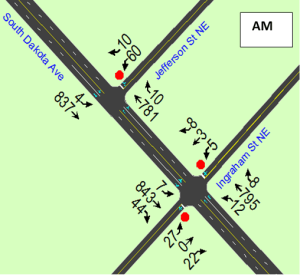
- AM Vehicle Count at Ingraham & Jefferson
-
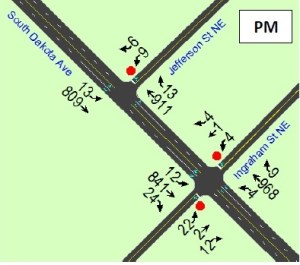
- PM Vehicle Count at Ingraham & Jefferson
-

- Pedestrian Count at Ingraham & Jefferson
DDOT conducted a study per their standard 2009 manual practice in response to “perceived unsafe crosswalk conditions [including for the blind and elderly].” A “Professional Traffic Engineer” assessed vehicular and pedestrian volumes at “stop-controlled intersections” on Wednesday, December 6, 2017, during the peak hours of 8:00 am to 9:00 a.m. and 5:00 pm to 6:00 pm.
| Ingraham | Jefferson | |
| Distance from Signalized Intersection | 250 ft from Hamilton | 275 ft from Kennedy |
| Vehicles | 1700-1900 | 1700-1900 |
| Pedestrians | 43 | 28 |
| Bicyclists | 4 | 4 |
| Vehicle-Vehicle Crashes (01/01/2013-12/31/2015) | 3 | 3 |
In addition to the pedestrian, bicyclists, and vehicular counts, the report also noted the following items related to the intersections:
- Posted speed limit was 25 Miles Per Hour
- Adequate minimum vehicle stopping and intersection sight distances
- Correct placement for existing signs and pavement markings, but no pedestrian warning signs at crosswalks
- Observed pedestrians using crosswalks
- Observed single drivers, but not those in “a platoon,” stopping for pedestrians
DDOT used a scoring matrix to evaluate the need for a HAWK signal. A simplified version is shown below with the score from their 2017 study (refer to the full report for explanation of the variables).
| Variable | Points Possible | Points Awarded |
| Pedestrian and Bicycle crashes (over recent 3-year period) | 20 | 0 |
| Vehicle Crashes (over recent 3-year period) | 10 | 6 |
| Street Traffic Volume | 30 | 30 |
| Number of lanes at peak hour | 30 | 10 |
| Elderly and disabled population | 10 | 0 |
| Proximity to K-12 School | 15 | 9 |
| Connection to parks, rec center, commercial, etc. | 15 | 15 |
| Metro station / bus stop | 20 | 0 |
| Posted speed limit | 15 | 5 |
| Distance to nearest signalized intersection | 30 | 0 |
| Crosses bike path | 5 | 0 |
| Total | 200 | 75 |
The Decision
According to their data, vehicular and pedestrian traffic counts warranted a HAWK signal at Ingraham street. But, as their report states, “satisfaction of meeting a warranting criteria shall not in itself justify the installation of a new traffic signal. Rather multiple site-specific factors must be considered, and engineering judgment applied before justifying any change in traffic control.”
Though we received an overall failing grade, the report also recognized pedestrian volumes would likely increase when the retail at the Modern opens.
Here is my take
For starters, their study does not appear to be the most rigorously designed. From being conducted on a single day, for only two hours, by one person, likely with temperatures that discouraged walking, lack of good lighting, and the Modern apartments barely open with no retail at that time, it seems unlikely that accurate and usable data would be obtained as the basis to make a decision.
The proximity to two other signalized intersections (Kennedy and Hamilton) appear to be the biggest reason why a HAWK signal was denied. Generally speaking, DDOT discourages traffic signals from being placed within 300 feet of each other because “challenges [exist] with signal coordination, driver confusion and lack of vehicle queuing space.” Putting aside the fact that HAWK signals have been installed to “help pedestrians safely cross [other] high traffic volume streets” (I’m looking at your ”mid-block crosswalk” Cleveland Park), I do find it dismaying that they would cite “driver confusion” here when pedestrian safety is just as critical (see any recent editorials on Vision Zero). The truly funny thing is that if the traffic signal had been installed at Ingraham to begin with, instead of being kept at Hamilton, then that would actually be more than 300 feet from the lights at Kennedy and Galloway.
DDOT also cites the “adequate sight distance for pedestrian visibility,” lack of pedestrian involved traffic crashes, and that “gaps” in through traffic are created with the current signal timing plan as additional factors to not install a HAWK signal. However, anybody waiting to cross those intersections would likely attest to the inadequate visibility they feel as pedestrians, especially when attempting to navigate the gaps in the platoon of cars barreling down South Dakota Avenue.
Speaking facetiously of course, I guess we need to have more pedestrian-involved crashes first to have more points on the DDOT scoring matrix, which would then help justify our request for increased pedestrian safety. But seriously, we really should not be waiting until any other unfortunate tragedies such as this one occur before the city takes action to install pedestrian safety measures within 250 feet of another signal. When it comes to the lack of pedestrian and bicycle crash incidents from 2013-2015, the Ingraham intersection in question did not even exist. The apartment building was under construction most of that time and the new street did not exist. A more appropriate use of pedestrian safety data would be all the 311 submissions neighbors have made regarding near crashes and other concerns since this intersection has been accessible by foot.
Going back to DDOT’s scoring matrix, no points were given for the elderly and disabled populations, despite that being part of the premise for the study. The intersection’s proximity to the metro did not yield points either, even though Ingraham is the through street to the metro.
Finally, DDOT did not independently act on a list of additional recommendations that were made in the report. Instead, neighbors needed to make numerous 311 requests to prompt the pedestrian safety enhancements. Such requests ended up being similar to the report’s recommendations unbeknownst to us, such as increasing crosswalk monitoring and installing high visibility pavement markings for the Jefferson Street crosswalk.
What’s Next
This is not the end of the story. At both the December Lamond-Riggs Citizens Association meeting and the brainstorming session, DDOT agreed to perform another study to evaluate if a HAWK signal is warranted now. Let’s hope they work with the community to design the best study possible.
Please join us at the next Advisory Neighborhood Commission 5A meeting where the topic of increasing pedestrian safety crossing South Dakota Avenue will be discussed. A draft resolution will be presented to the Commissioners as well. The meeting will be Wednesday, January 30, 2019 at 6:45 p.m. at UDC-CC Backus. If you want to submit a letter of support regarding this issue, please email a 250-word statement here.
 Next Stop...Riggs Park
Unbelievable. 0 point for metro/bus stop? 0 for elderly/disabled population? Not to mention the DDOT rep explicitly said the reason they declined to install a hawk signal was due to low pedestrian volume, which he claimed was 20 individuals crossing during the time of their observation. Now we learn it was more than double that number. It’s hard to see the purpose of conducting another traffic study when they did this one so poorly, then misrepresented the findings, already committed to installing a Hawk signal last year, and submitted plans years ago that included a full traffic signal at the Ingraham intersection. Looks like negligence.