Companion Guide to Lamond-Riggs Library Heritage Wall

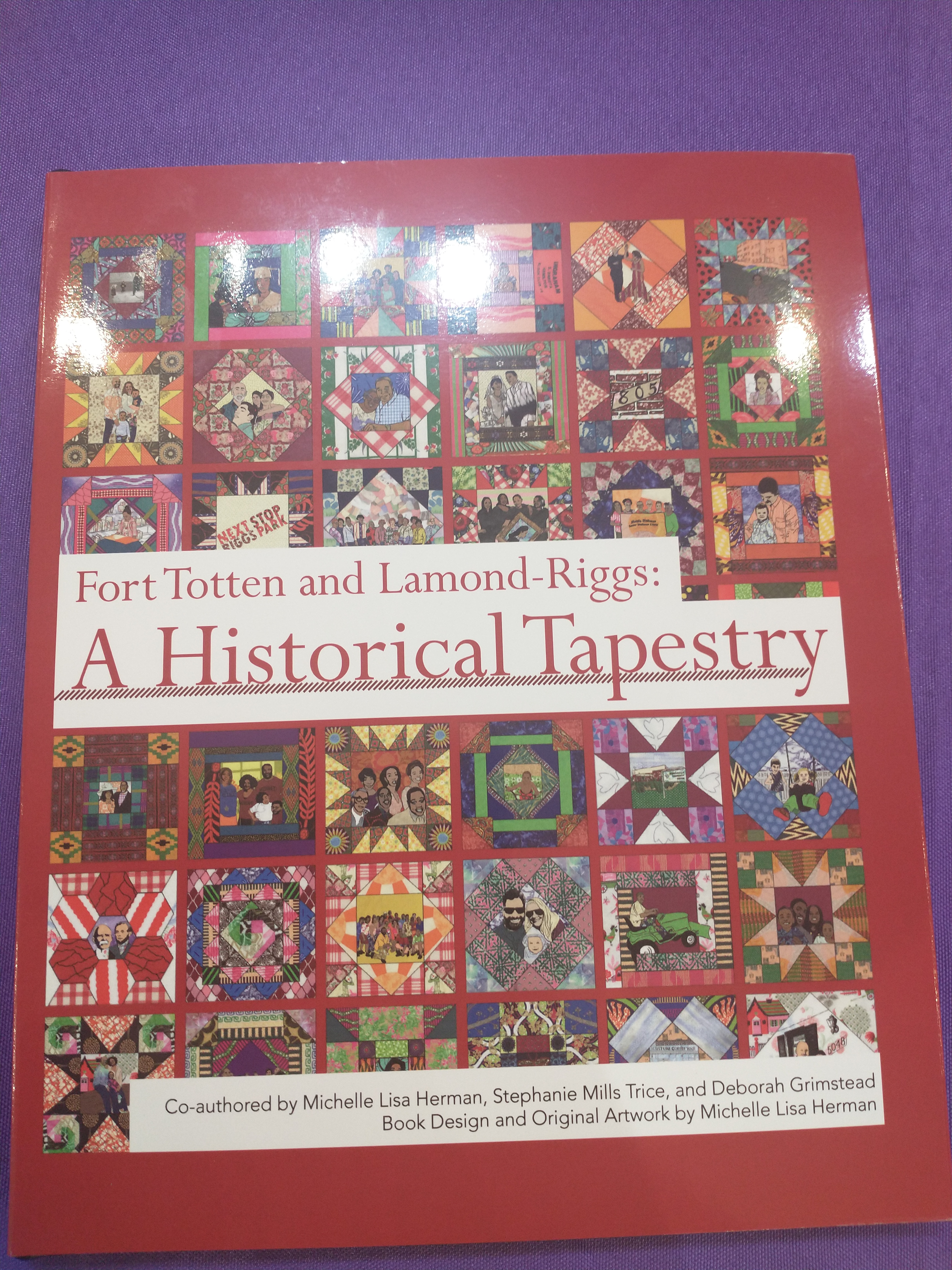
The Heritage Wall at the Lamond-Riggs Library now has a beautiful companion book, “Fort Totten and Lamond-Riggs: A Historical Tapestry,” co-authored by Michelle Lisa Herman, Stephanie Mills Trice, and Deborah Grimstead. The book stitches together written narratives and excerpts of oral histories from contributors to the Heritage Wall, as well as photos of the original artwork from the permanent installation.

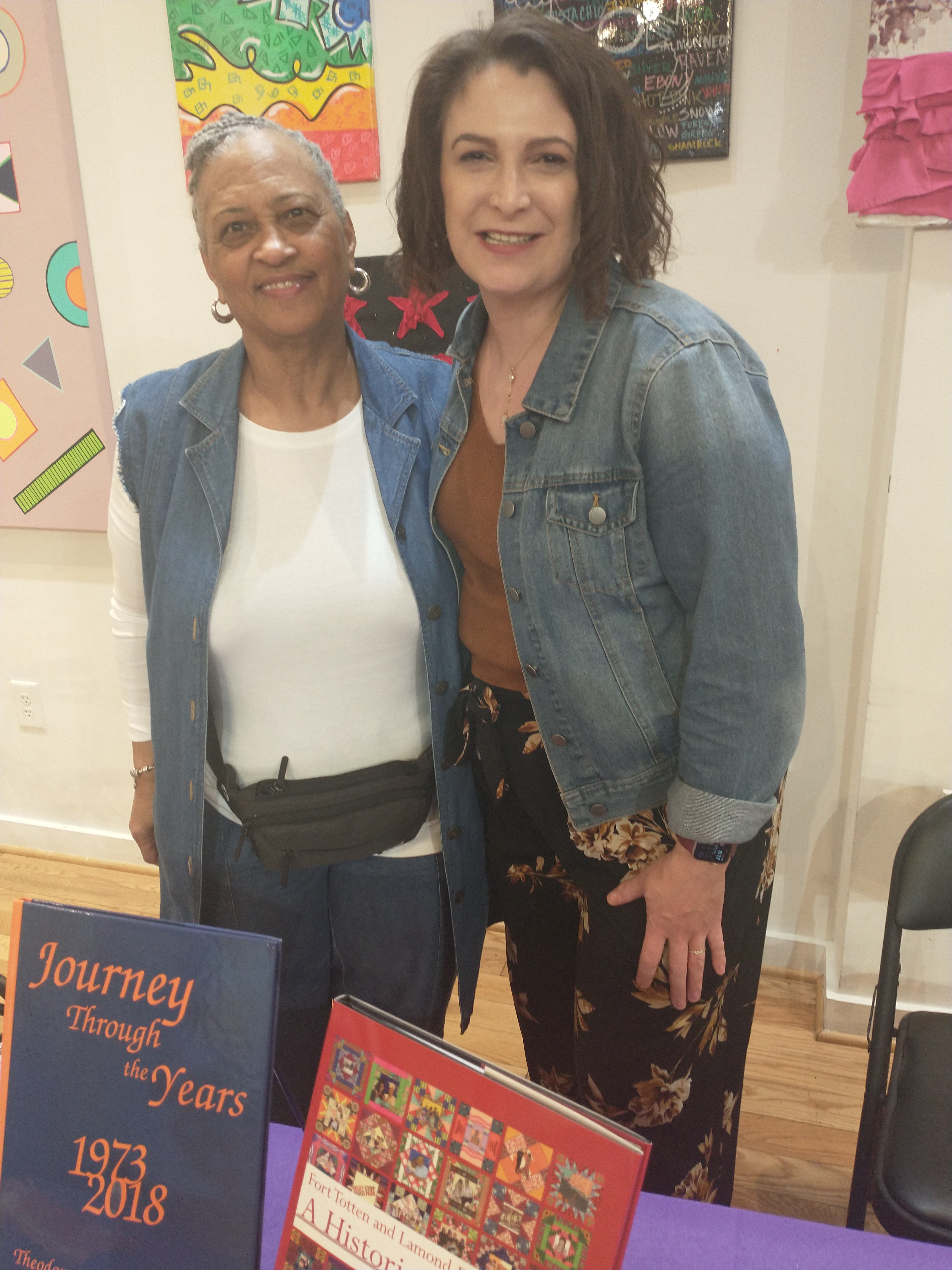
Ms. Herman, a multidisciplinary artist, created the stunning Heritage Wall at the Lamond-Riggs Library. Ms. Mills Trice created the DC Fort Totten Storytellers oral history project several years ago. The two teamed up to apply for a Community Culture & Heritage Projects grant from HumanitiesDC to produce a companion guide for the Heritage Wall. Local resident Ms. Grimstead volunteered with the project team. The three worked together for one year doing research, conducting roughly 11 interviews with participants, collecting text submissions from participants, and designing the book. Ms. Herman and Ms. Mills Trice presented the final product at the HumanitiesDC Community Showcase at the Anacostia Arts Center on April 10, 2025.

The book is available to read free online at https://www.michellelisaherman.com/fort-totten-and-lamond-riggs-project. Copies of the book will be given to local organizations, and a few copies will be available for viewing at the Lamond-Riggs Library soon. Books may also be purchased at-cost (the cost of printing) through Blurb.

The project team is finishing up work with the People’s Archive to house the oral histories at the DC Public Library. The oral histories will eventually be publicly available at https://digdc.dclibrary.org.

Existing interviews from Ms. Mills Trice’s Fort Totten Storytellers are available at https://digdc.dclibrary.org/do/cd3a1f05-f5d1-4a08-9a7e-02cc55869d02.

I am looking forward to listening to the oral histories from the tapestry project once that work is completed. It was such a treat to be able to see the finished book at the community showcase and talk to other teams doing incredible projects across the city. (Seriously, people are doing really interesting, culturally rich work all over the city supported by HumanitiesDC).

The Heritage Wall deserved an equally beautiful companion piece, and the project team delivered. Kudos to Ms. Herman, Ms. Mills, Trice, and Ms. Grimstead for their wonderful contribution capturing the history and people of our local neighborhoods.

Lamond-Riggs Library Heritage Wall Participants – Tell Story of Your Contribution by August 31, 2024

Deadline extended to August 31!

During the Lamond-Riggs/Lillian J Huff Community Library “Heritage Wall” dedication event and artist talk last year, many attendees expressed an interest in an “index” to complement the artwork. Artist Michelle Lisa Herman and Stephanie Mills Trice have been awarded a Humanities DC grant to develop a printed publication to serve as both an “index” of the Heritage Wall and to highlight the history of the Lamond-Riggs and Fort Totten area. Copies of the final publication will be distributed to neighborhood organizations and the library.

Michelle and Stephanie are now asking for previous participants and contributors to tell the story of their contributed materials and their connections to the Lamond-Riggs and Fort Totten neighborhoods so they may include them in this publication. 

They would love for you to fill out this form to supply information about your contributions, or if you prefer, provide contact information so they can conduct a short oral history interview. 

Please fill out the form by August 31 here https://forms.gle/WR314Cn938STy5E48

Fort Totten and Lamond-Riggs: A Historical Tapestry Project – Call for Contributions Survey

During the Lamond-Riggs/Lillian J Huff Community Library “Heritage Wall” dedication event and artist talk last year, many attendees expressed an interest in an “index” to complement the artwork. Artist Michelle Lisa Herman and Stephanie Mills Trice have been awarded a Humanities DC grant to develop a printed publication to serve as both an “index” of the Heritage Wall and to highlight the history of the Lamond-Riggs and Fort Totten area. Copies of the final publication will be distributed to neighborhood organizations and the library.

Michelle and Stephanie are now asking for previous participants and contributors to tell the story of their contributed materials and their connections to the Lamond-Riggs and Fort Totten neighborhoods so they may include them in this publication. 

They would love for you to fill out this form to supply information about your contributions, or if you prefer, provide contact information so they can conduct a short oral history interview. 

Please fill out the form by July 31 here https://forms.gle/WR314Cn938STy5E48

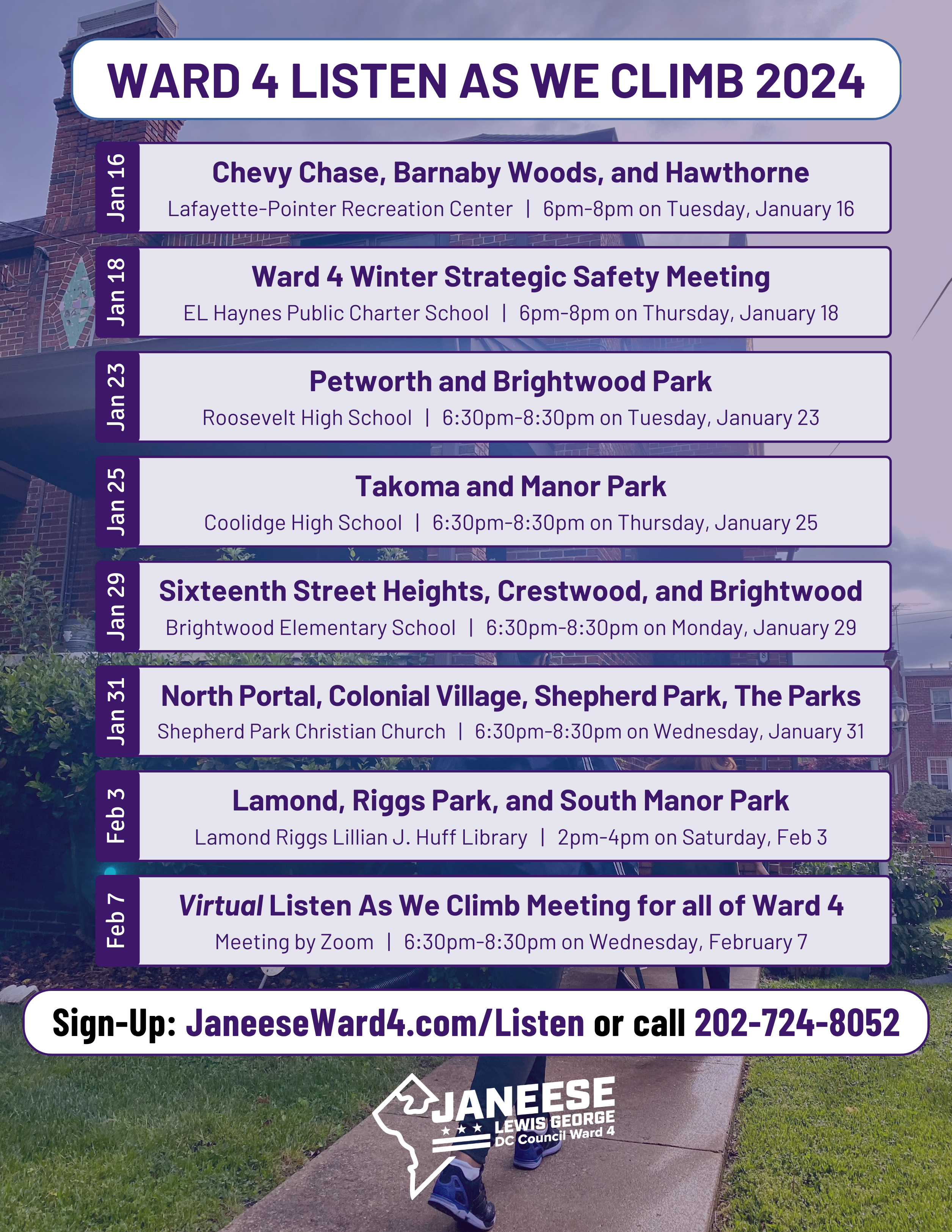
February 3: Ward 4 Councilmember Janeese Lewis George Lamond-Riggs Listening Session

Ward 4 CM Janeese Lewis George Listening Session for Lamond-Riggs
February 3, 2024
2:00 pm-4:00 pm
Lamond-Riggs Library
5401 South Dakota Avenue NE

Register at janeeseward4.com/listen or call (202) 724-8052.

Help inform CM Lewis George’s legislation, budget priorities, constituent services, and community initiatives. These listening tour sessions have been useful in the past, so please attend a session if you can. There is space on the registration form to enter questions/comments in advance of the session.

A virtual session will also be held on February 7, 2024, from 6:30 pm to 8:30 pm for those who cannot or do not wish to attend an in-person session.

Pilot Shuttle Program for Ida B. Wells Students

In her recent newsletter, Ward 4 Councilmember Janeese Lewis George shared news that DC School Connect has launched a new pilot that will transport neighborhood students to Ida B. Wells Middle School. Councilmember Lewis George notes that the walk from Riggs Park to the feeder middle school is roughly 1.5 miles (longer from certain parts of the neighborhood) and involves crossing busy roads. The DC School Connect shuttle will pick up students near LaSalle-Backus Elementary School in the morning and drop them off back there after school. More info and sign-up at https://www.dcschoolconnect.com.

Origin of Chillum Place Name

Patricia K. Timbers, a neighbor on Chillum Place NE in Riggs Park, wrote to the Washington Post to ask the origin of the Chillum name. The Post explained that the name comes from Chilham Castle in England. An individual named William Digges recorded the property that sits along the DC/Maryland border and named the parcel Chillum Castle Manor.

In 1763, William Digges patented 4,443 acres of property that today straddles the border of the District and Prince George’s County. That means that he had the property surveyed and registered with the proper authorities. Digges’s acquisition was a consolidation of nine parcels, including 506 acres of something known as Yarrow Head, 620 acres of Smyrna and 1,120 acres of Widows Purchase.

Digges decided to call the newly patented parcel Chillum Castle Manor. This was a reference to the family’s ancestral home back in the county of Kent in southeast England. That ancestral home is in the village of Chilham and is itself called Chilham Castle. You can guess how it’s pronounced: CHILL-uhm.

Kelly, John. “What’s in a name? For Chillum, the story begins at an English castle.” Washington Post July 15, 2023.

The article offers a few other interesting tidbits about the history of the name. Check it out.

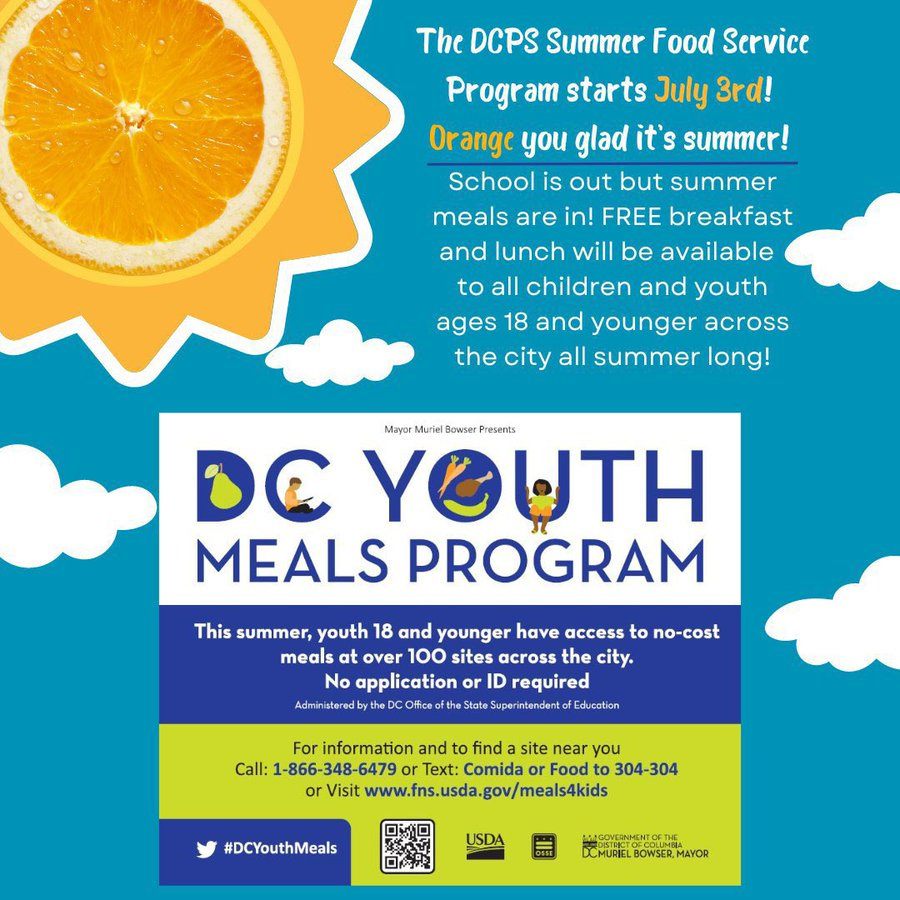
2023 Free Summer Meal Sites for Youth

Youth 18 years old and younger can eat free meals at a number of sites across the city, including a few in the neighborhood and nearby.

  • Bertie Backus Campus (5171 South Dakota Ave. NE)

Open June 26, 2023 through August 3, 2023

Meals served Monday-Friday

Breakfast: 8:30 am-9:30 am

Lunch: 12:00 pm-1:00 pm

  • North Michigan Park Recreation Center (1333 Emerson St. NE)

Open June 26, 2023 through August 18, 2023

Meals served Monday-Friday

Breakfast: 8:30 am-9:30 am

Lunch: 12:00 pm-2:00 pm

  • Riggs LaSalle Recreation Center (501 Riggs Rd. NE)

Open June 26, 2023 through August 18, 2023

Meals served Monday-Friday

Breakfast: 8:30 am-9:30 am

Lunch: 12:00 – 2:00 pm

  • Lamond Recreation Center (20 Tuckerman St. NE)

Open June 26, 2023 through August 18, 20123

Meals served Monday-Friday

Breakfast 8:30 am-9:30 am

Lunch: 12:00 pm – 2:00 pm

Snack 3:00 pm-4:00 pm

The Freeway Revolts and Lamond-Riggs

By Gavin Baker (Guest contributor)

As the Commemorative Works Technical Assistance Program is soliciting ideas for important events and figures to memorialize in Wards 4 and 5, it’s a good moment to reflect on the freeway revolts and their impact on Lamond-Riggs and surrounding neighborhoods.

Post-War Context

The District’s population, both Black and white, boomed with the expansion of federal government and military jobs during the New Deal and World War II. The 1950 Census recorded DC’s highest population ever, more than 800,000, a number it has yet to reach since.

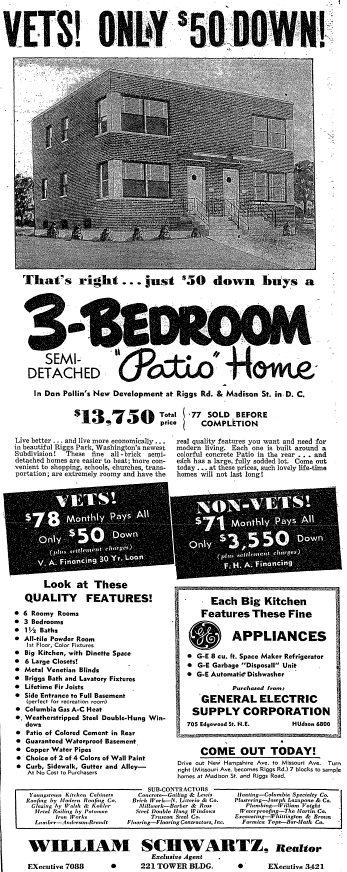
With the demobilization following WWII, more resources became available to build new housing for that booming population. In June 1950, the first ads appeared in the Washington Post and the Evening Star for a new development: “Live better… and more economically… in beautiful Riggs Park, Washington’s newest Subdivision!” The ads highlighted the offer for veterans to buy a house with just a $50 down payment.

The name “Riggs Park” appeared in the Washington Post for the first time in this ad on June 25, 1950. (via ProQuest Historical Newspapers)

The suburbs boomed, too, and in the 1950s, DC’s population underwent major changes. In 1950, the city’s population was 65% white; by 1960, it was 54% Black. The 1960 Census showed the first decline in the District’s overall population in its history, which would continue for each of the next four decades.

White flight to the suburbs was driven by both racial and economic factors, one of which was transportation. Automobile usage swelled: in the 1950s, American auto manufacturers sold one new car for every three residents. To serve them, U.S. governments embarked on efforts to extend and widen roads, including an influx of federal funding under the Federal-Aid Highway Act of 1956, signed by President Eisenhower.

“White Man’s Road thru Black Man’s Home”

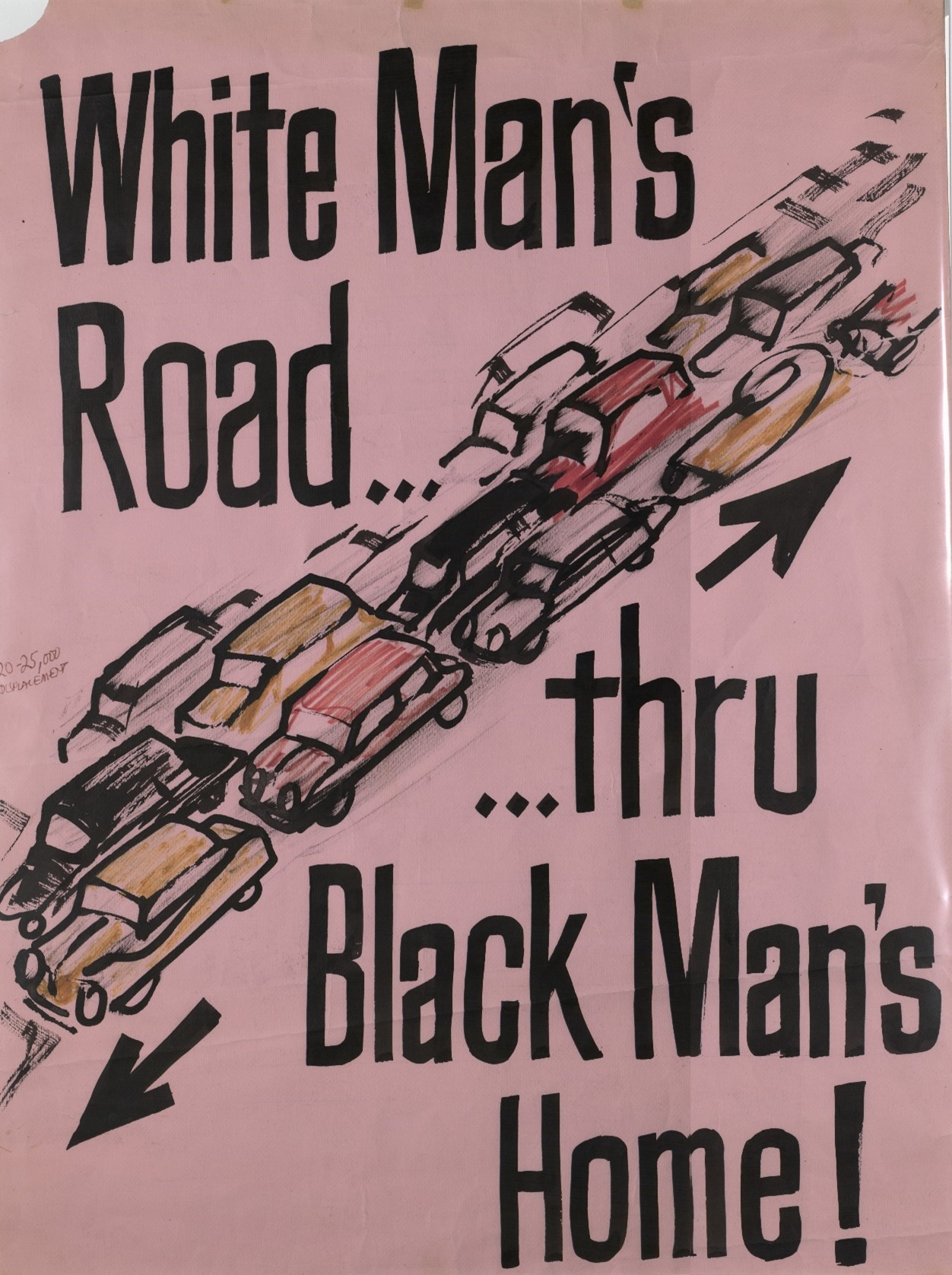
Against this context, officials developed plans to expand freeways in DC, which protesters would come to deride as “White Man’s Road thru Black Man’s Home.”

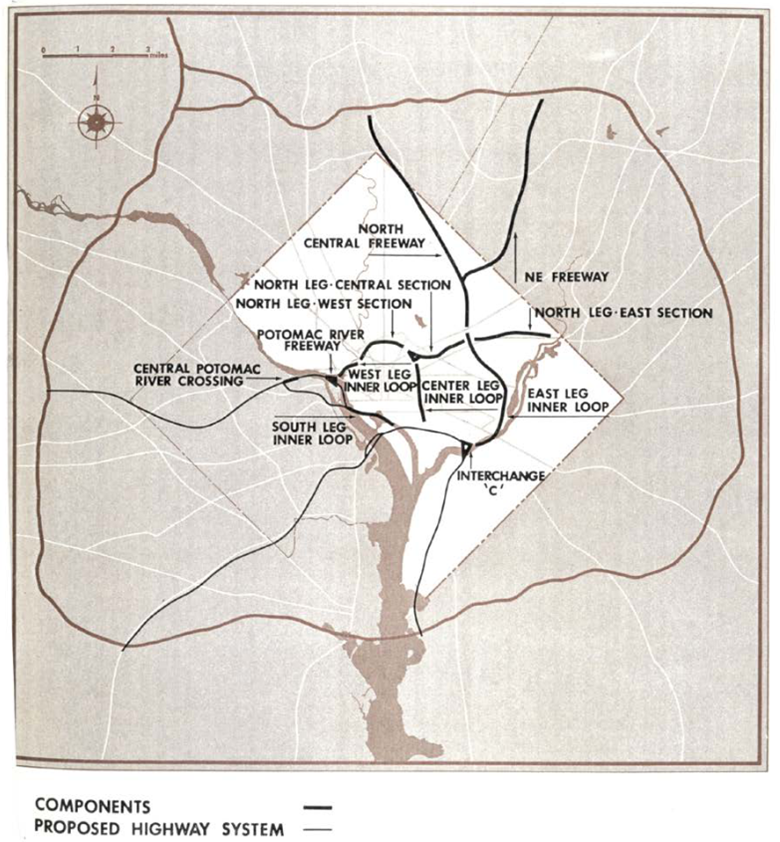
In Wards 4 and 5, planners aimed to build the North Central Freeway through neighborhoods such as Brookland, Michigan Park and North Michigan Park, Lamond-Riggs, and Takoma. Fort Circle Park would have been paved over to become the Northeast Freeway. If these plans had succeeded, today our neighborhood would be a highway interchange.

A 1966 map of proposed highways in DC.

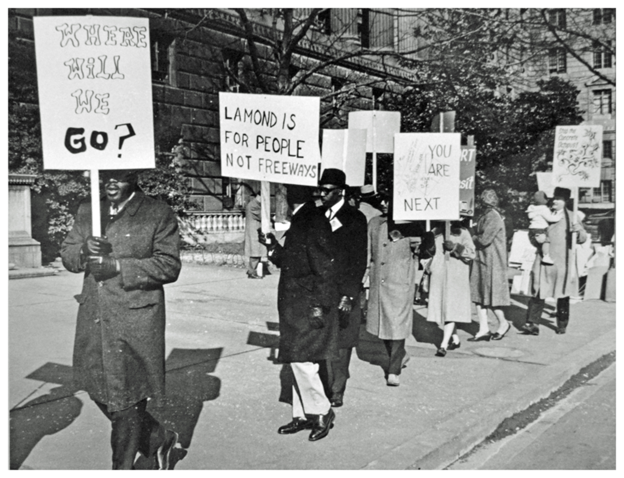
They didn’t succeed – because of the freeway revolts. A multiracial coalition of activists banded together in the 1960s to oppose the destruction of neighborhoods, the pollution that would result from the freeways, and the prioritization of (largely white) suburban commuters over (largely Black) urban residents. The freeway opponents, by and large, won: most of the planned freeways, including the North Central Freeway and the Northeast Freeway, were never built. By the 1970s, the remaining plans were formally withdrawn.

Emergency Committee on the Transportation Crisis poster

Lamond-Riggs is not merely a footnote to this history. Simon Cain, president of the Lamond-Riggs Citizens Association, served as the first chair of the Emergency Committee on the Transportation Crisis, the focal point of opposition to the freeway plans.

1965 protest against the planned North Central Freeway

The freeway revolts were a watershed moment for racial and environmental justice in DC. If the freeways had been built, our neighborhoods would be radically different, with more traffic, more noise, more pollution (and related diseases like asthma), and more disinvestment. Lamond-Riggs would be somewhere to drive through, rather than somewhere to live.

There were other notable consequences of the freeway revolts. The protests were a launching pad for future leaders, including Marion Barry (who would later serve as Mayor of DC) and Sammie Abbott (who would later serve as Mayor of Takoma Park). In addition, the revolts led to the creation of Metrorail as an alternative to freeways. Today, Metro’s Red Line parallels the planned route for the North Central Freeway, serving Brookland, Fort Totten, and Takoma – without having paved them over.

May 14: Lamond-Riggs Boys & Girls Club Reunion Event

Lamond-Riggs Boys & Girls Club Reunion & Community Welcoming

May 14, 2022
12:00 pm-1:00 pm
Riggs-LaSalle Recreation Center
501 Riggs Road NE

Note: Due to expected rain, some of the outdoor activities for this event have been cancelled. Everyone is invited to attend the indoor program at 12:00 pm.

Lamond-Riggs Boys & Girls Club Reunion & Community Welcoming event will celebrate the rich history and numerous successes yielded by the Lamond-Riggs Boys & Girls Club (LRBGC) located in Northeast Washington, D.C. The products of this community remain the cornerstone of many families within the community, reside with families throughout the District, Maryland, Virginia areas and also around the world. The reunion will acknowledge the past and present of this community landmark who have benefited and/or supported the LRBGC in building the lives of successful women and men. The services afforded to the LRBGC community over the years have built foundational success for many youth and families which have contributed to the influence of exceptional doctors, educators, business leaders, community leaders, clergy and numerous other professions.

12:00 PM – 1:00PM

Community Awards & Recognitions

Community Development/Support
Parent Involvement
Founders & Administrators
Cheerleaders
Coaches

Links to Lamond-Riggs & North Michigan Park Candidate Forums

The Lamond-Riggs Citizens Association (LRCA) and the North Michigan Park Civic Association (NMPCA) did a great job of hosting two candidate forums for the upcoming primary election earlier this week .

The Ward 5 DC Council candidate forum was held on May 10, 2022. Participating candidates: Kathy Henderson, Gordon Fletcher, Zachary Parker, Faith Gibson Hubbard, Vincent Orange.

The DC Mayor candidate forum was held on May 9, 2022. Participating candidates: James Butler, Mayor Muriel Bowser, At-large Councilmember Robert White. Mayor Bowser did let the associations know ahead of time that due to a prior commitment, she would be late. She arrived about 44 minutes into the forum.

Links to view the forums are below.

Ward 5 DC Council Candidate Forum, May 10, 2022 (2 hours)

DC Mayor Candidate Forum, May 9, 2022 (2 hours) (forum starts around 4:35 mark)

The primary election is June 21, 2022. Ballots will be mailed to registered voters begining May 16, 2022. Useful information about the primary election, including mail ballot drop box locations, vote center locations, and instructions on how to register to vote or update voter registration information, is available on the DC Board of Elections website at https://dcboe.org/PrimaryElection2022.

Tonight May 10: Lamond-Riggs & North Michigan Park Ward 5 DC Council Candidate Forum

Reminder: Ward 5 DC Council Candidate Forum, hosted by the Lamond-Riggs Citizens Assocation and the North Michigan Park Civic Association, is tonight at 6:30 pm

Confirmed:
Gordon Fletcher
Kathy Henderson
Faith Gibson Hubbard
Gary Johnson
Vincent Orange
Zachary Parker 

Join the webinar online via Zoom

https://us06web.zoom.us/j/88562218708?pwd=TmllTHlUL0phdUl3RlNoZzBodktOdz09
Passcode: 362936

-or-

Dial-in by phone using one of the phone numbers below

(646) 558-8656 or
(301) 715-8592 or
(312) 626-6799
Webinar ID: 885 6221 8708
Passcode: 362936

Or, view on YouTube: bit.ly/LRCAYouTube

Tonight May 9: Lamond-Riggs & North Michigan Park DC Mayor Candidate Forum

Reminder: DC Mayor Candidate Forum, hosted by the Lamond-Riggs Citizens Assocation and the North Michigan Park Civic Association, is tonight at 6:30 pm

Confirmed:
Mayor Muriel Bowser
James Butler
Councilmember Robert White 

Join the webinar online via Zoom

https://us06web.zoom.us/j/88562218708?pwd=TmllTHlUL0phdUl3RlNoZzBodktOdz09
Passcode: 362936

-or-

Dial-in by phone using one of the phone numbers below

(646) 558-8656 or
(301) 715-8592 or
(312) 626-6799
Webinar ID: 885 6221 8708
Passcode: 362936

Or, view on YouTube: bit.ly/LRCAYouTube

Reminder: Lamond-Riggs & North Michigan Park Mayor & Ward 5 Council Candidate Forums May 9 & 10 – Submit Questions by May 6

From LRCA & NMPCA

The Lamond-Riggs Citizens Association (LRCA) in conjunction with the North Michigan Park Civic Association (NMPCA) will host two virtual Candidate Forums in anticipation of the upcoming District elections.

Mayoral Candidate Forum
Monday, May 9, 2022
6:30PM to 8:30PM

Ward 5 Candidate Forum
Tuesday, May 10, 2022
6:30PM to 8:30PM

These virtual Candidate Forums will be hosted on Zoom and streamed to both Facebook and YouTube for your easy access. The sessions will be moderated and will feature pre-selected questions from members of our community. If you have a question(s) that you wish for the forum candidates to respond to, you may submit them in advance for consideration: 

To view the Mayoral Candidate Forum on Monday, May 9, or the Ward 5 Council Candidate Forum on Tuesday, May 10

https://us06web.zoom.us/j/88562218708?pwd=TmllTHlUL0phdUl3RlNoZzBodktOdz09

Meeting ID: 885 6221 8708

Passcode: 362936

Dial in by phone: (301) 715-8592

Watch on Facebook at https://www.facebook.com/lrcadc

Watch on YouTube at https://bit.ly/LRCAYouTube

Lamond-Riggs & North Michigan Park Mayor & Ward 5 Council Candidate Forums – Submit Questions in Advance

The Lamond-Riggs Citizens Association (LRCA) in conjunction with the North Michigan Park Civic Association (NMPCA) will be hosting two candidate forums in time for the upcoming District election races in June.

Mark your calendar and plan to join in for both of these informative events.  This will be your chance to learn more about the candidates that hope to serve you as your elected District officials.

The District of Columbia Mayoral Candidate Forum
Monday, May 9, 2022
From 6:30PM to 8:30PM
The session will be conducted online via Zoom.  The session will also be streamed to both Facebook and YouTube.  Link and page information to come.

Ward 5 Member of the Council Candidate Forum
Tuesday, May 10, 2022
From 6:30PM to 8:30PM
The session will be conducted online via Zoom.  The session will also be streamed to both Facebook and YouTube.  Link and page information to come.

Submit questions for the candidates in advance at https://lrcadc.org/2022-lrca-nmpca-candidate-forum.

Mayor’s Proposed Fiscal Year 2023 Budget

Yesterday, Mayor Muriel Bowser shared part of her proposed fiscal year 2023 budget with the DC Council. Additional parts of the budget will be released over the next few days. I have not taken a look at any of it yet (I have been looking at those ANC boundary discussion maps!). But resident Gavin Baker passed along his initial take on budget items in or close to Lamond-Riggs that he is kindly permitting me to share on the blog, copied below.

  • Riggs-LaSalle Recreation Center to get a roof replacement in FY23.
  • LaSalle-Backus Elementary School modernization is still included on the same timeframe as last year’s budget (project to start in FY27). Unclear if a swing space in the area will be provided during construction (Truesdell and Whittier are also scheduled for modernization in the next few years and folks have asked for a local swing space during those projects).
  • UDC Bertie Backus campus to get funding for renovations and building addition. There’s also still $500K in this year’s budget, not yet used, for beautification at UDC Backus.
  • The Eastern Ave. rehabilitation and Lamond-Riggs streetscape projects are still listed, although the amounts and timing are not specified in these documents.
  • Nearby:
    • A new DC Public Library in Manor Park/Brightwood Park is funded (replacing the current Shepherd Park library), exact site TBD; project to start in FY27. (The new Lamond-Riggs Library is already fully funded, under construction, and expected to open this summer.)
    • Fort Totten Trash Transfer Station is funded for design and construction of pollution prevention and stormwater treatment best management practices.
    • The Metropolitan Branch Trail Blair to Piney Branch and 1st Pl. to Oglethorpe projects are still listed, although the amounts and timing are not specified in these documents.
    • The North Capitol St. project is still listed, although the amount and timing is not specified in these documents.
    • Coolidge High School to get a separate kitchen and dining area (currently shared with Wells Middle School).
    • North Michigan Park Recreation Center to get playground improvements in FY23.

Details in the FY 2023 documents here: https://cfo.dc.gov/page/annual-operating-budget-and-capital-plan

Editor’s Note: I will just add for reference the budget request letters sent to Mayor Bowser by Ward 4 Councilmember Janeese Lewis George and Ward 5 Councilmember Kenyan McDuffie before Mayor Bowser shared the first part of her budget with the Council. A few highlights from CM Lewis George’s letter include (1) a request for funding for swing space in Ward 4 for when Truesdell, Whittier, and LaSalle-Backus undergo modernization (advocated by ANC 4B, ANC 4D, and many residents); (2) a request for some specific improvements to Lamond Recreation Center (advocated by the Lamond-Riggs Citizens Association under the leadership of Barbara Rogers) and improvements to Riggs-LaSalle Recreation Center (advocated by the Friends of Riggs-LaSalle Recreation Center under the leadership of Tischa Cockrell with board member Robert Oliver, as well as LRCA, based on longstanding requests from staff and residents); and (3) a request to accelerate funding for rehabilitation of Eastern Avenue NE (advocated by just about everyone in the eastern part of Ward 4 and several nearby in Ward 5). Worth taking a look at both letters to see all of the good things the Councilmembers requested.

More to come when Mayor Bowser releases her full budget.

Preserving our Neighborhood Story: Documenting the History and Leadership of Lamond-Riggs

Guest post by Sarah Shank

Post updated

Before the widespread availability of the internet, communities were built in the streets and on porches. This is how and where neighbors connected, news was shared, and families celebrated. It was rare that neighborhood happenings would go unnoticed. Community leaders united the neighborhood by spreading neighborhood news, organizing neighborhood watches, igniting local activism, and welcoming new neighborhood residents.

Lamond-Riggs is a community of leaders. Our residents have done this for decades and continue to be a force in the District. Even the mayor got her start in politics living in this corner of the diamond–first as ANC, then councilmember, then mayor–before moving to Northwest.

After living in DC for more than 20 years – in many different neighborhoods across the District – I’m proud to now call Lamond-Riggs home. While I’m a newcomer to the neighborhood (going on only 2 years now), I picked to live in this neighborhood for a few reasons: its established community, commitment to its residents, and the neighborhood family feel that it retains. I’m continually amazed by the civic engagement that residents have and the rich history that surrounds us.

We are a neighborhood of firsts.

And while many of these firsts are from way before my time, but none are by any means small and I’m just naming a few!

  • The first Summer Cultural Enrichment Program under the sponsorship of the Urban Services Corps was held at LaSalle Elementary School.
  • The first comprehensive cultural enrichment program sponsored by the Neighborhood Planning Council and DC Public Schools was held at Bertie Backus Junior High School.
  • The Lamond-Riggs Athletic Association was the first to organize little league football teams in DC.

We are a neighborhood of activists.

As the headline to a 1988 Washington Post article notes, “For a small neighborhood tucked away in a corner of Northeast Washington, Riggs Park has made a lot of noise over the years.” So from the creation of Bertie Backus Junior High School in the 1950’s, to the freeway fights of the 1960’s and 1970’s, to construction of Fort Totten metro station in the 1970’s, to construction of the neighborhood library in the 1980’s and now again today – throughout  time, residents developed and maintained a thriving, mixed-income community with strong civic participation.

Come to any Lamond-Riggs Citizens Association monthly meeting and you’ll see that civic engagement still happening to this day.

We are a neighborhood of families.

Young and old. Then and now. Our homes have yards and alleys. Our homes are filled with hard-working DC families. While accessible by metro, our neighborhood provides refuge from the daily grind. It has big open sky and it’s our home away from the city but still in the city – aren’t we lucky!

Founded in 1980, the Humanities Council of Washington, DC (HumanitiesDC) aims to enrich the quality of life, foster intellectual stimulation, and promote cross-cultural understanding and appreciation of local history in all neighborhoods of the District. They allow neighborhood organizations and individuals to apply for grants to help document and share their story of DC through oral histories. Through these DC Oral History Collaborative grants, HumanitiesDC aims to document and preserve the stories and memories of residents by making existing oral history recordings more accessible and giving residents the training and financial resources they need to conduct quality interviews.

With this type of financial support, we together can record the stories that bore witness to the neighborhood’s early years, allowing us the opportunity to capture key moments in the neighborhood’s history over the past seven decades. These stories should be documented and shared with our own community as well as have our civic pride touted to every other corner of DC.

I’m eager to apply on behalf of our neighborhood because I see tremendous value in the stories that we have in Lamond-Riggs. But to do this, I need the help and support of all my neighbors and friends. Our residents have a unique view of this Capitol city that I want that not only recorded, but also shared.

Send me your ideas.

Send me your photos (I promise to scan and return them).

Tell me your memories.

The grant application is due on January 25, 2019. This means there is still time to include as many of our community ideas into the grant application as possible. If we are awarded the grant, the funds will be used to record oral histories from five to ten Lamond-Riggs residents. We will supplement the recordings with photos. And if we have more people who want to tell their stories, we can always do more! Also, if we don’t win the grant, I still hope to begin collecting stories and documenting the legacy of our community and its residents so that this rich history can live on for generations to come.

I’m confident that by collecting and sharing these stories, we’ll be able to instill the same sense of community and activism in the next generation, so that they can continue to make this neighborhood one of firsts and families – much like it has always been.

Please feel free to comment below with comments and/or ideas. Or please send me a note directly here.

Hidden Neighbors Part 2: The Riggs

Guest Post by David Kosub

*** Please note David is only a citizen historian and apologizes for any incidental fake news. He hopes neighbors share these stories and are inspired to write about their community in the new year too.*** [Ed. Note: If you would like to contribute a blog post for Next Stop . . . Riggs Park, please send an email to nextstopriggs@gmail.com]

Welcome to Part 2 of our Lamond-Riggs naming story. As you may recall, we met the Lamonds in Part 1 of the series, learned to make Terra Cotta, and found out about a little ol’ horrific train disaster. With that introduction, let’s meet Riggs.

The President’s Banker 

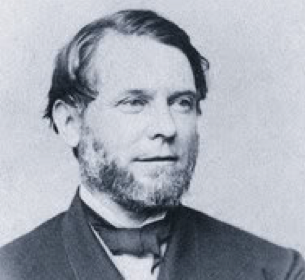
Picture of George Washington Riggs

Born on Independence Day in Georgetown in 1813, George Washington Riggs was definitely a firecracker. A true high-roller 19th century style, Riggs teamed with William Corcoran, of the present-day Dupont gallery fame, in what would become a very lucrative banking empire. Their bank, as a result of a government decision, was the only one allowed to obtain a large chunk of federal depositories in the city, leading to crazy profits. Rolling on all cylinders, they helped finance the Mexican-American War with over $15 million in loans from the federal government, provided over $7 million in gold for the purchase of Alaska, financed the development of the telegraph, provided funds to expand the Capitol, and resourced one of the first expeditions to the South Pole.

Multiple Presidents (including a Confederate one), Cabinet Secretaries, Senators, Generals, suffragettes, Red Cross founders, and many embassies entrusted their treasures with Riggs Bank. Riggs himself retired from the bank in the late 1840s, but his family had a stake in the institution until the early 20th century. In 1904, their new headquarters on Pennsylvania Ave was notable for its “Ladies’ Department,” designed to meet the special needs of women, including Clara Barton and Susan B. Anthony (ooh la la).

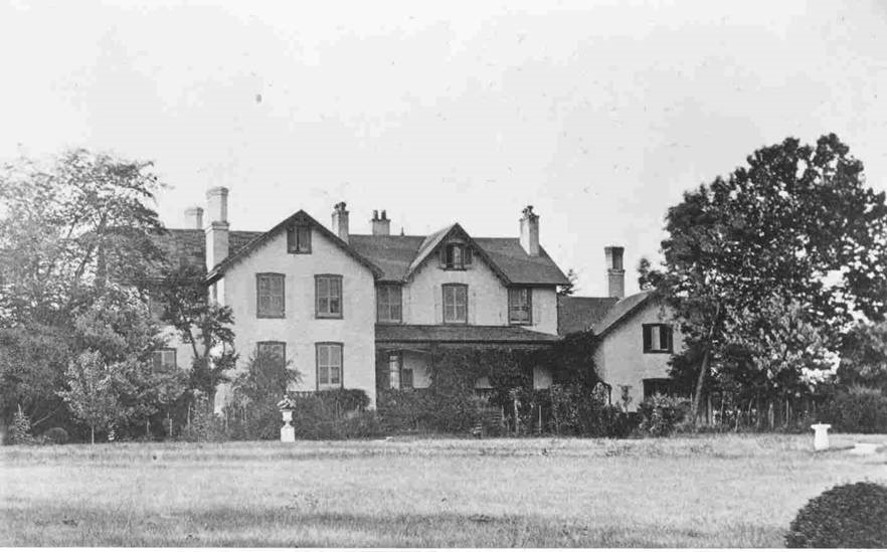
Riggs spent much of his time not too far from where you currently sleep. His 197-acre country estate was situated on a high vantage point, with views of the U.S. Capitol (though technically outside the city back then). You may know of this area now as the Armed Forces Retirement Home after the federal government purchased it from the Riggs estate in 1851 for $57,000 (after paying only $3,400 to purchase the site nine years earlier). It was on these grounds in the summer of 1862 where President Lincoln penned the final draft of the Emancipation Proclamation (only a dozen years after enslaved persons may have lived here too). Today, now recognized as a DC historic site and on the National Register of Historic Places, this property has sculptured landscapes, war memorials, and the original Gothic Revival-style cottage which bears the Riggs name.

Lincoln Cottage. Source

Because you cannot hide money, Riggs established a second country estate – a new, slightly more modest 140-acre one known for its “fine blooded cattle” in present day Silver Spring. Alas, this one had to be sold too, a mere week after a “skirmish” between Union and Confederate troops that left the nearby vicinity torched and plundered in 1864. Though 300 people died, the Riggs family suffered too, losing “some hay forage,” vegetables, and a valuable ox.” Today, the property serves as a private school for students with learning disabilities.

At the age of 68, Riggs passed away in his Green Hill home—yes, a third country estate, which was 342 acres in Hyattsville and included the only mill still surviving in Prince George’s County. An obituary crooned that Riggs was “remarkable for strength of mind and . . . power to grasp and fathom any subject presented to him . . . and in all his transactions, his judgement prompt, and his conclusions just.” Wow, it’s like reading a biography of yours truly. Not too far from the Lamonds, Riggs can also be found lazing around Rock Creek Cemetery too (section D, Lot 14) – just a 25-minute stroll from the community bearing his name.

Bankers to the Most Important Money in the World – Yours

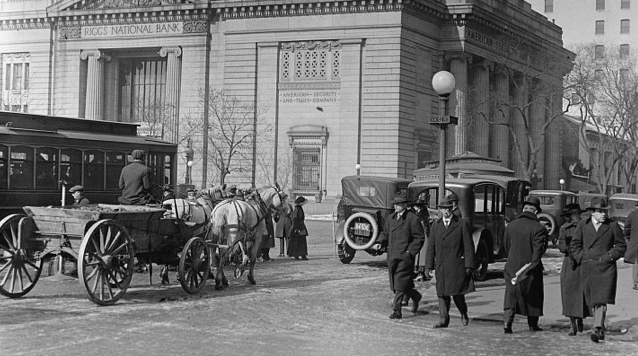
Now, let’s check back in with Riggs Bank (see these simply amazing commercials here, here, here and the 1980’s jingle here). Lasting over 150 years, with multiple iconic branches in the District, including Georgetown, Dupont, and across from the U.S. Treasury, it kind of fell with a thud. Though not as cool as this sort of Riggs downfall here, the bank’s failure in the early 21st century was just as epic and followed, wait for it . . . a handful of money laundering scandals resulting in the company paying millions in fines and penalties.

Image of Riggs National Bank ca. 1913-1918. Source

Remember those embassies mentioned earlier, and their treasures too? Well, various employees at Riggs Bank were caught embezzling over $30 million in oil revenues from the Embassy of Equatorial Guinea on behalf of that country’s dictator. One of the employees at the Dupont branch would apparently even walk up the road to the embassy and collect briefcases containing stacks of shrink-wrapped bills. The bank also was connected to yet another dictator, this time with Chile, helping him hide additional millions (see here how the bank tried to make good on this one). Federal reports also noted that the bank “inadequately monitored the destinations and uses of large amounts of cash, often more than $1 million at a time” in over 150 accounts linked to the Saudi Arabian embassy and ambassador (it even got a shout out on Meet The Press). And, of course, the bank was linked to the CIA too, because, why not?

 Alternative facts: What If . . . 

It is still unclear to me, however, why our neighborhood went from being known as Terra Cotta to Lamond-Riggs (Lamond & Riggs Park neighborhoods collectively) today. I find it a shame because Terra Cotta sounds pretty cool actually. I would like to believe that it goes deeper than just the nature of evolving communities and adjacent streets . . . like maybe the two families knew each other at some point in their life.

Perhaps Riggs issued a loan to Lamond to start the plant, who then reciprocated with a gift of the first clay tile hot out of the oven. Or, maybe Alcena caused an uproar at a citizen’s association meeting over the most hyper-local issue of the day — overgrown trees, unsafe pedestrian crossings at train tracks, silent invocations, and potholes, yes definitely potholes. Perhaps they shared stories over a pint during a Thirsty Third Terra Cotta Thursday too.

Regardless of the reason, we all live here together and have made it the tight, close-knit community it is today. As history happens every second of every day, let’s continue to create it, stroll through it, welcome it, and learn about the hidden mysteries that exist right under our noses.

Hidden Neighbors Part 1: The Lamonds

Guest post by David Kosub 

*** Please note David is only a citizen historian and apologizes for any incidental fake news. He hopes neighbors share these stories and are inspired to write about their community in the new year too.*** [Ed. Note: If you would like to contribute a blog post to Next Stop . . . Riggs Park, please send an email to nextstopriggs@gmail.com]

Back in 2011, all around the DMV, we found ourselves asking, “What is NoMA anyways”? After Amazon made its announcement, we found ourselves wondering something similarly–“National Landing, really”? I guess it’ll be called NaLa soon enough.

Even closer to our “scrappy, down-home” neighborhood, if you want to see sparks fly, then ask someone about what they think about the name “Fort Totten Square,” or about their initial impressions of “Fort Totten” metro. But, be careful. Make sure you do not call it Fort Totten-Riggs station though. For that matter, where did the name “Lamond-Riggs” come from anyways–or as I call it, LaRi?

Here, in this two-part series, I sought to uncover this mystery and meet the elusive Lamond and Riggs. In Part 1, let’s start by turning the clocks back about a century and a half and meet the Lamonds.

Terra Cotta Warriors: A Different Type of Baked Earth in Washington

There is a silty, reddish clay earth right beneath your feet. This soil, the bane of many area gardeners – like yours truly – who just want to grow some darn tomatoes and peppers in their yard, actually contributed to a vibrant industry over a century ago. Heating this ample clay-ground proved perfect for making a certain material commonly found in sculptures, flower pots, pipes, bricks, roofing tiles, and even metro platform embellishments.

And, voila, the Terra Cotta neighborhood was born. The Federal government officially recognized this description in 1979, the same year as the names Lamond-Riggs and Fort Totten Park, and it still existed as recently as 2007.

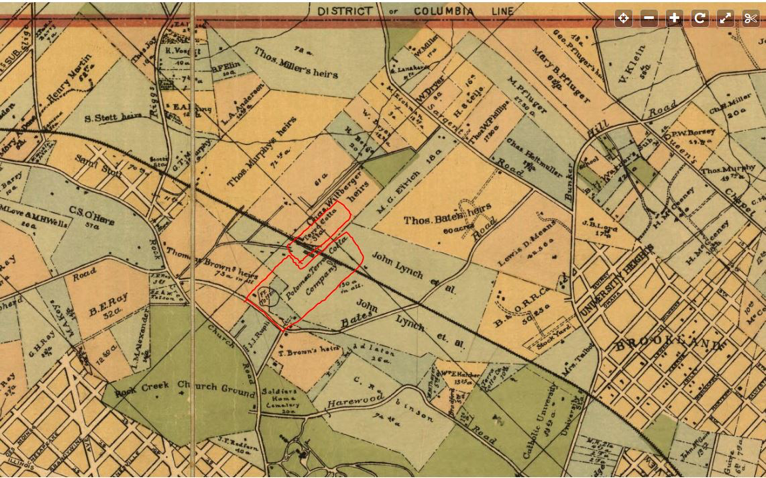
This name is linked to a thriving business established here in the latter half of the 19th Century, the Potomac Terra Cotta Company. Its impressive, large ovens could be seen creating clay tiles on the eastern side of the recently laid Baltimore and Ohio train tracks, near today’s Van Buren Street, Underwood Street, and Chillum Place.
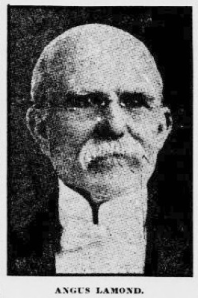
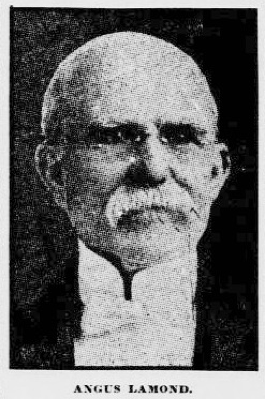
Picture of Angus Lamond

Drum roll please, this company was the brainchild of one Scottish-born Angus Lamond. He started the company some time after immigrating to the United States at the age of 25. With Gaelic and Norse origins, his family name meant “the law man” and was llikely pronounced “Laumon.” If you cannot get enough Game of Thrones, check out this actual ancestral history of the Lamonts of Tiree, from which our hero Angus may have derived.

In 1873, officials with the railroad, specifically the Metropolitan Branch rail line, moved the nearby Brightwood station closer to the company, renaming it Lamond Station or Terra Cotta. Likely located somewhere between where Fort Totten and Takoma metro stops are today, the relocation of this simple, three-sided wood-framed structure caused some consternation. The railway thus justified the move by explaining that the station was better protected from vandals at the new site.
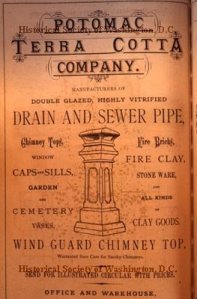
Advertisement for Potomac Terra Cotta Company. Source:

The new station served another role too, incentivizing people to move to an unincorporated parcel of land destined to be a nuclear-free, suburban oasis located “high above the swampy, malaria-ridden Washington City.” When Alcena Lamond, Angus’s better half, encountered it in 1875, she lamented that the area “was all that a wilderness could be.”

Even with the fear of the unknown, the Lamonds would come to embrace the wild. The town would grow without regard for jurisdiction, incorporating part of the large Riggs estate (but we will get to Riggs later in Part 2). By 1889, this “place only for the wild creatures of nature” expanded from the original 5 homes—one of which was the Lamonds—to over 200.

The call of the wild was so strong that Angus and Alcena even donated land for a library, though not likely the one you are envisioning. Angus allegedly convinced his childhood friend Andrew to give a $40,000 construction grant, which together with the land, eventually became the Takoma Park Carnegie library in the early 20th century. Before it could become reality, the contribution of the “best men” in Takoma Park needed to testify at a House hearing in 1907, including Angus who was glorified as one of the “most generous” and “prominent” citizens during the lovefest. A Congressman touted the library would be a “valuable addition to the educational facilities of the District of Columbia . . . [and] that the remoter sections of the District are entitled to the largest possible use of the Washington  Public Library.” Let’s keep that in mind as our local branch gets its own upgrade over the next couple years!
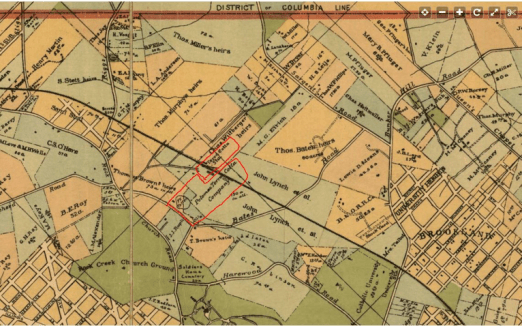
1890 map of Terra Cotta neighborhood. Company and railroad are circled in red Source

Alcena, the true rock star she was, worked her magic on the 57th Congress to pass legislation in 1902 to incorporate the Eastern Star Home for the District of Columbia. This institution was a home for “needy and worthy [fathers, their widows and orphans, and members] of the Order of the Eastern Star of [the District of Columbia].” The Order of the Eastern Star is a Masonic group (complete with its own International Temple in Dupont) that recognized her as a Grand Matron in 1896. Angus was prominent in Masonic circles too, recognized as a Grand Patron. The Eastern Star Home, essentially a nursing home off New Hampshire Ave NE, naturally (being D.C. and all) was destined to be a future sight for a zoning fight between the District, neighbors, and developers over a century later.

Meanwhile, back at the Terra Cotta Plant, work was seemingly difficult producing those clay tiles. For starters, it claimed the life of one of their sons in a tragic clothing-related accident in 1922. The other son also lost an arm while working in the factory. But, despite this incident, this son would successfully manage the company for decades until its closing in the mid-1950s (so, give him a hand for that, he needs it). Some of their clay fixtures can even probably still be found on houses in our neighborhood today.

Angus, who died in 1917 around the age of 75, and Alcena, who died in 1932 around the age of 82, both now leisurely hang out right around the corner in Rock Creek Cemetery (Section R11, Lot 49, Grave 3 and Grave 1respectively). They are just a 25-minute stroll from the community bearing their name, so pay them a visit.

Train Spotters (caution ahead)

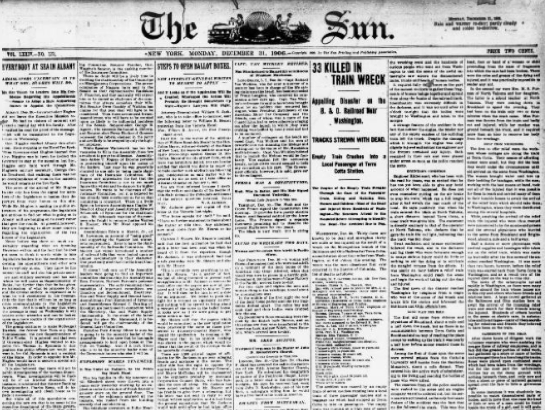
For an additional, unfortunate twist of fate, the Lamond/Terra Cotta station is known for the worst train disaster in Washington D.C. history, one hundred years before the one you are likely thinking about. This accident was later recounted in the book Undergraduate Days 1904-1908 as a “terrible noise…of an explosion, escaping steam, breaking wood, groaning brakes and human screams” heard as far away as Brookland and Catholic University. A newspaper recounted that “the butchery of the passengers was one of the most frightful things in the history of railroading.” They were cut into pieces and portions of their bodies scattered all along the track. When all was said and done, 53 passengers lost their lives, over 70 were injured, and none of the engineers on the offending train were found guilty of manslaughter.
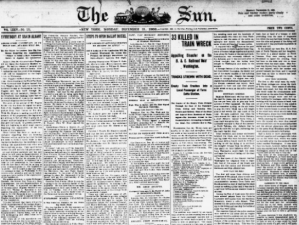
Image of newspaper article on train crash

A citizen historian who spent 10 years studying the crash opined that this incident “hastened the conversion of passenger cars from wood to steel and led to improvements in railroad signaling,” so I guess there is that silver lining. Though if you need another pick-me-up right about now, as I did when writing this, then see this happy story about the Fort Totten metro train tracks before going to bed.

So, that was the Lamonds. Stay tuned for Part 2 of our naming saga in which we’ll learn about bankers, emancipation, and dictators, oh my . . .