
By David Kosub (Contributor)
…Then in 1885…the room (in what is now the Hay Adams Hotel) is warm, yet still somehow oddly…cold. Quiet, except for the sound of wood burning in the fireplace. Smell of almonds perfuming the still air. Photograph developing chemicals are spilled on the ground. The body of a woman lies lifeless on a rug nearby. The husband who finds her is devastated.
…Now in 2020…her restless spirit continues haunting the grounds where her body lies for eternity…grounds, which may be uneasy to hear, lie very close to you. Read on, if you dare.
Marion “Clover” Hooper Adams was an interesting character in her day. Sure, she was married to Henry Adams—of Boston Presidential family notoriety–but but she was oh so much more. An accomplished photographer for her day, she captured images that became a commentary on the role of women in society and domestic life.

She also experienced severe mental illness and depression. And, on one fateful day, she brought her 42 year life to an end by swallowing some of the very same developing chemicals that brought her photos to life. Chemicals, no less, that commonly contained potassium cyanide.
No suicide note found. So, why did she do it? Some say it was the loss of her father months back. Some think it was the claustrophobia caused by the domestic role of women in her day. Some believe it was because Henry stymie her artistic ambitions. Maybe it was the affair she learned about? Regardless, her suicide haunted Henry’s psyche for the rest of his life (even though she was not mentioned once in his award winning autobiography).
Henry commissioned a statue for Clover years later. Inspired by the Buddhist principle of nirvana, it depicted his anguish over her death in bronze for hereafter. The anonymous and androgynous figure, now overlooking her grave site encircled by conifers and granite, hides behind a shroud. And, if you look at its face, you too will understand the grief he must have felt. When Henry passed a few decades later, he too was buried right there under the gaze of the contemplative figure. You can walk through it here.
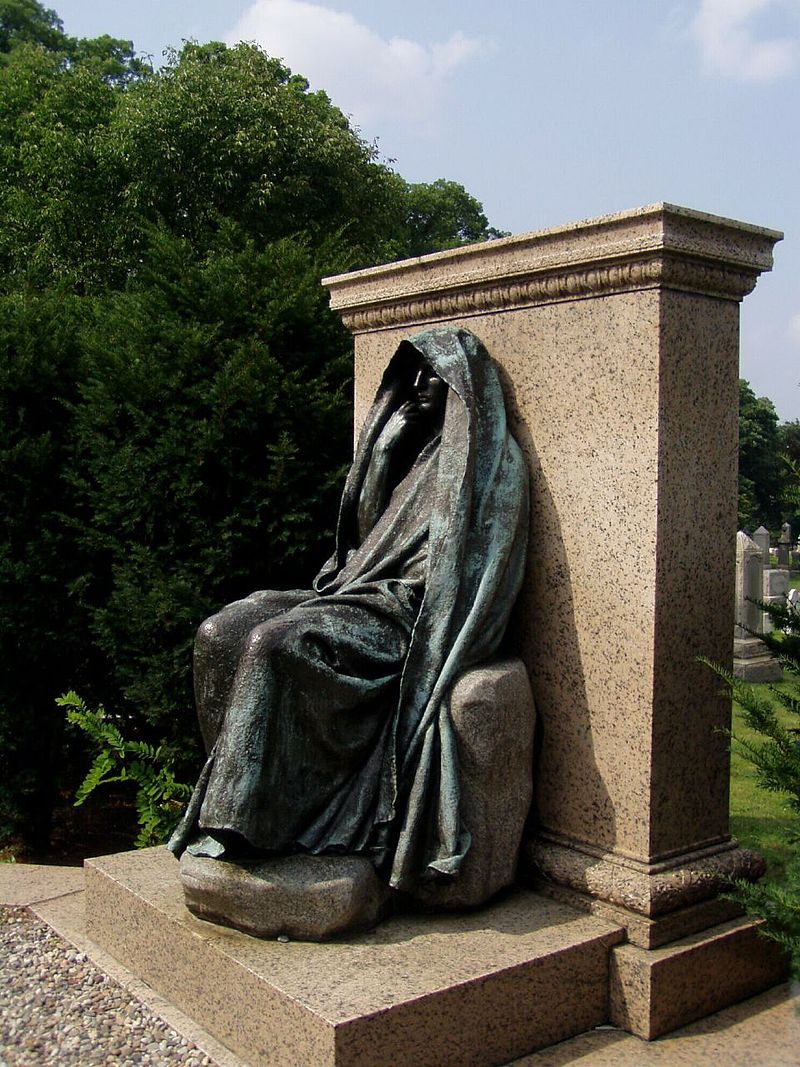
Those who visit the site say they can strongly feel Clover’s presence. Others, after time spent near the statue, are overtaken by sadness, grief, and despair. Both Clover and Henry have been seen wandering the grounds. Now, it’s time for you to experience the site and feel their grief firsthand. Their spirits are both right here, a short 30 minute walk from Riggs Park, in Section E of Rock Creek Cemetery, right off Allison St NW and North Capitol.
If you miss Clover during your visit, that may be because she is getting payback in nearby Pikesville, Maryland. A couple decades after the statue began overseeing her eternal resting place, General Felix Agnus made an illegal replica of it for his own family plot. Since then, visitors have experienced strange activity at the so-called Black Aggie statue (watch this video). Legend has it that “her” eyes glow red at night, which could make you go blind if looked upon. Grass refused to grow nearby. Pregnant women would miscarry if walking through her shadow. And, naturally, you would die from extreme fright if you sat on her lap or stayed overnight with her. After frisky teens and drunk college kids kept breaking into the Druid Ridge cemetery to get their late night kicks, the family shipped the statue off to the Smithsonian for safekeeping in the late 1960s. Eventually, Black Aggie would reside outside the Dolly Madison House in Lafayette Square, mere steps from the hotel where Clover took her own life.
If you are the type of person who likes staying overnight near an androgynous shrouded statute with glowing eyes in a cemetery, well, then you should write next year’s Riggs Park spooky post. I suspect you have some interesting stories to tell…Happy Halloween!
 Next Stop...Riggs Park