
The District Department of Transportation (DDOT) held two public meetings to discuss next steps for the South Dakota Avenue NE Corridor Safety project.
See DDOT South Dakota Avenue Corridor Safety Project Website.
See DDOT South Dakota Avenue Corridor Safety Presentation (July 2025).
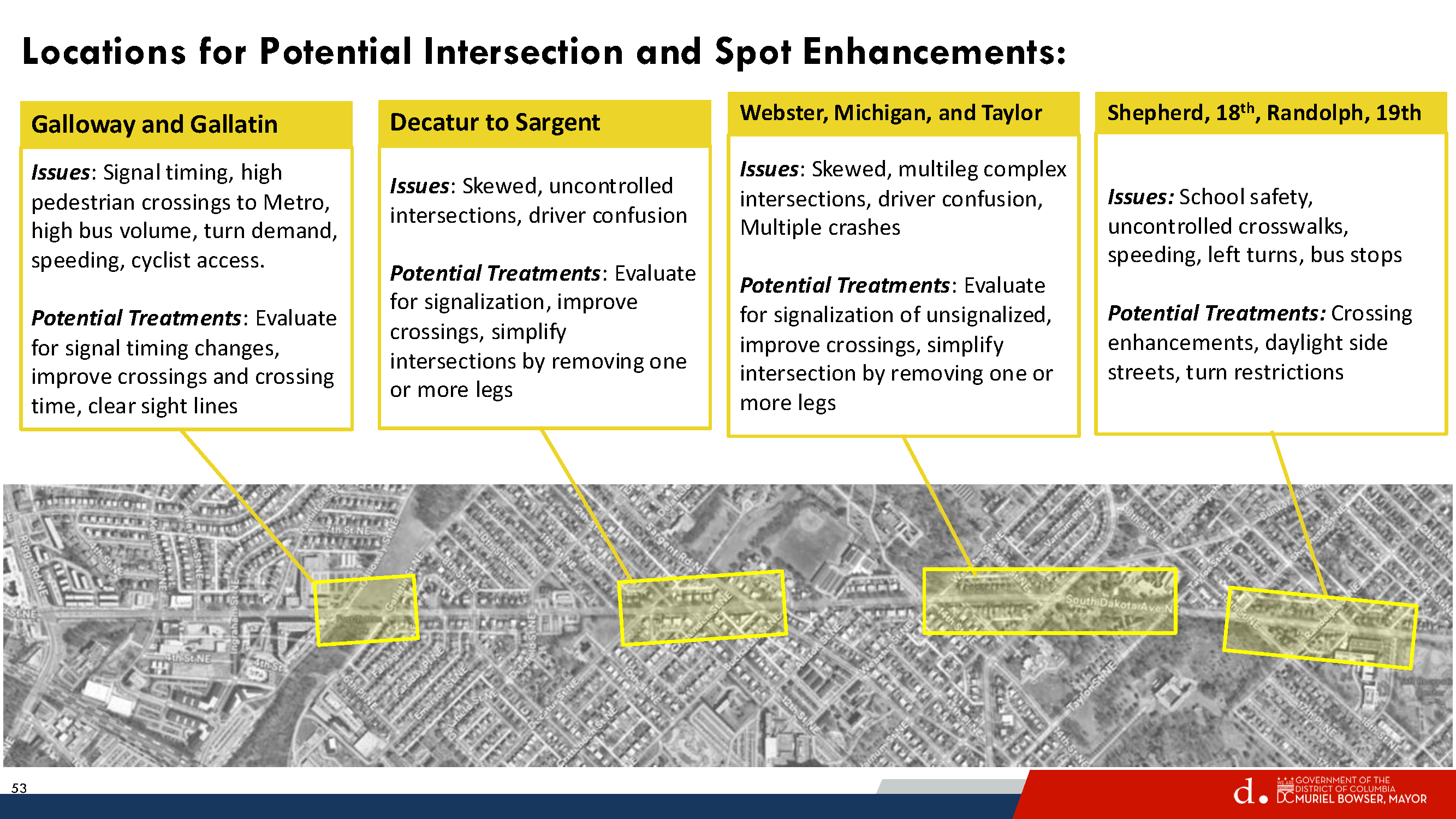
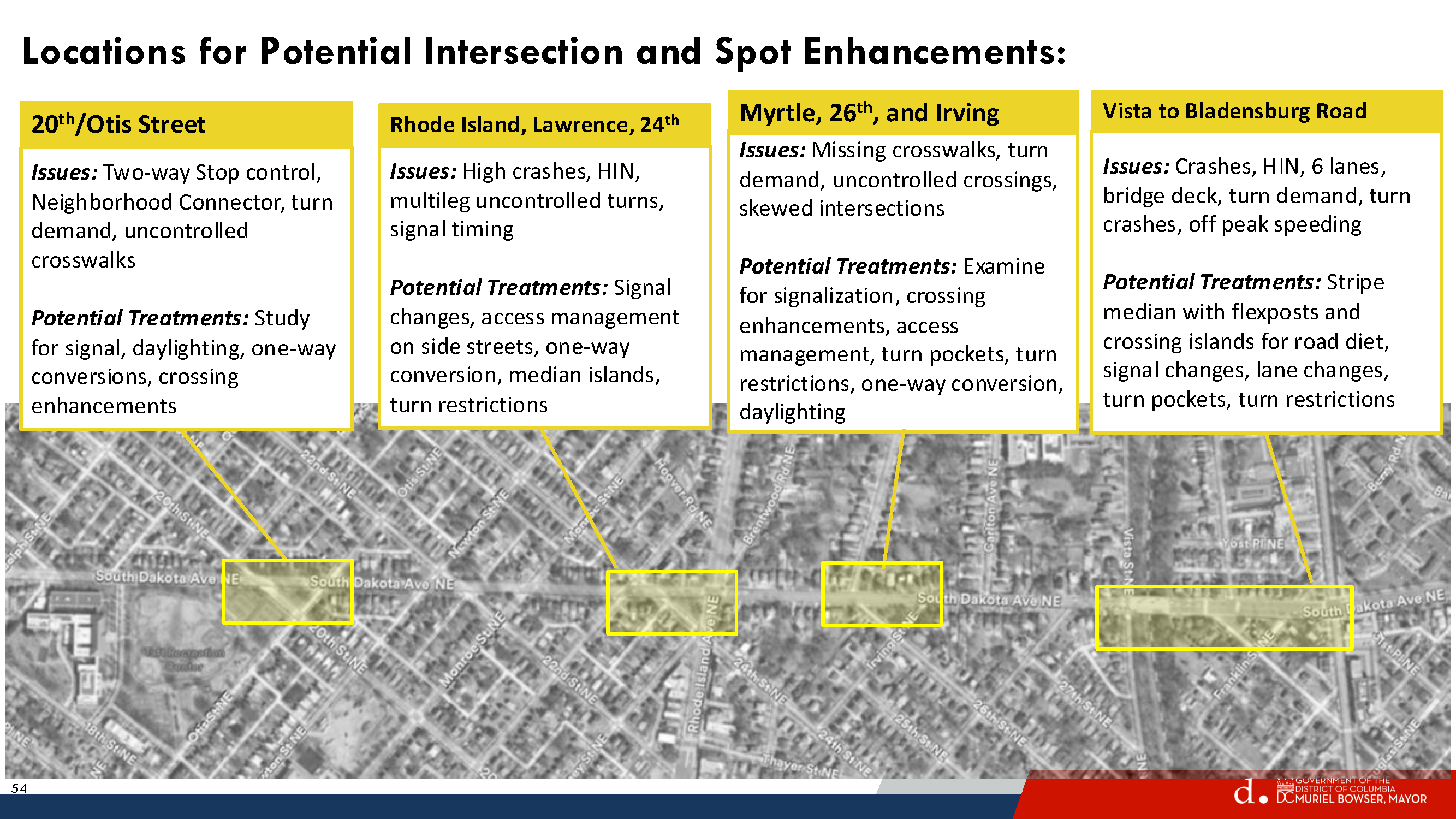
The tl;dr is that DDOT will not be doing a road diet. Instead, they will focus on spot treatments at a few problematic intersections. DDOT has a new survey asking residents to rank possible locations for spot treatment. South Dakota & Galloway is one of the intersections being considered. South Dakota & Decatur is another.
For South Dakota & Galloway, they would potentially look at signal timing and improvements to crossings and cross time. For South Dakota & Decatur, they would potentially look at signalization, improvements to crossings, and simplifying the intersection.
If you care, take the survey and rank the locations. You can also suggest other locations for consideration.
Complete the DDOT Spot Treatment Survey this week.
Road Diet Feasibility
It is worth taking at a look at the presentation slides and project website. DDOT explained how they determine whether a road diet is feasible. They explained the impact of a full road diet to travel the entire South Dakota Avenue corridor from Bladensburg to Riggs to show that delay would be minimal.
- On weekdays, northbound motorists would see a 1 minute decrease in travel time for the entire corridor during morning peak and a 4.7 minute increase during evening peak.
- On weekdays, southbound motorists would see a 7.3 minute increase in travel time for the entire corridor during morning peak and a 2.7 minute increase during evening peak.
- On weekends, a full road diet would increase travel time 42 seconds going northbound and 2.3 minutes going southbound.
They also shared travel time impacts at key intersections. Spot treatment modeling videos are on the project website:
South Dakota AM Road Diet Comparison
South Dakota PM Road Diet Comparison
(One thing a resident pointed out to me is that these numbers are based on present day; the study does not take into account planned development along/near the corridor.)
A full road diet for the entire corridor would cost around $6.5 million. DDOT does not plan to seek funding necessary for a road diet, choosing to focus their efforts on the previously identified high risk corridors. DDOT will publish the safety study and keep it in DDOT’s library for future reference. They will use the $600,000 remaining in the project budget on spot treatments at a few locations.
Spot Treatments
Examples of safety treatments that may be implemented include:
- New Traffic Signal Installation
- Curb Extensions (Bulb-outs)
- Pavement Marking Improvements
- Turn Lane Modifications
- No Turn on Red
- Left-Turn Traffic Calming
- Rectangular Rapid Flashing Beacons (RRFBs)
- HAWK Signal (Pedestrian Hybrid Beacon)
- Median Refuge Islands
DDOT discussed the costs of common treatments. A full traffic signal costs $300,000. Markings signs, and side street safety treatments can cost $10,000- $50,000 per intersection. Concrete improvements can start at $50k for a curb extensions or median island. So if DDOT puts a traffic signal at one of the intersections, that will use up half of the $600,000 budget for spot treatments. DDOT shared all of this to manage expectations and to emphasize that there will be tradeoffs depending on what is most important to residents.
As ranked by number of comments received, the number one and number two locations of concern were (1) South Dakota & Galloway and (2) South Dakota and Riggs. But DDOT does not plan to address South Dakota & Riggs any time soon. A DDOT representative first told me it is not part of Ward 5 (it partially is) and then they said that Riggs needs its own corridor study and that “we need to talk to our councilmember,” referring to the Ward 4 councilmember.
(Aside: This is pretty typical where the executive and council pass the ball back and forth and make residents jump through hoops again and again and do repeated backflips to get a known problem addressed. In this case, one that the city is responsible for poorly designing in the first place. Moving on.)
DDOT will select locations for spot treatment based on a few factors, including safety data and community input.
Selection criteria include:
- High Injury Network intersections – areas with a history of severe or fatal crashes.
- Intersections with high crash rates – based on recent traffic collision data.
- School zones – especially where children frequently walk, bike, or cross busy streets.
- Unsignalized multi-lane crosswalks – crossings that lack traffic signals and are challenging for people to navigate safely.
- Resident-identified areas – any additional locations where the community has raised serious safety concerns.
During the meeting, DDOT stated they will prioritize locations based on crash data and turning movement (primarily looking at left turn conflicts with pedestrians). After the public presentation, DDOT told me they will also consider input from Councilmember Parker.
Timeline
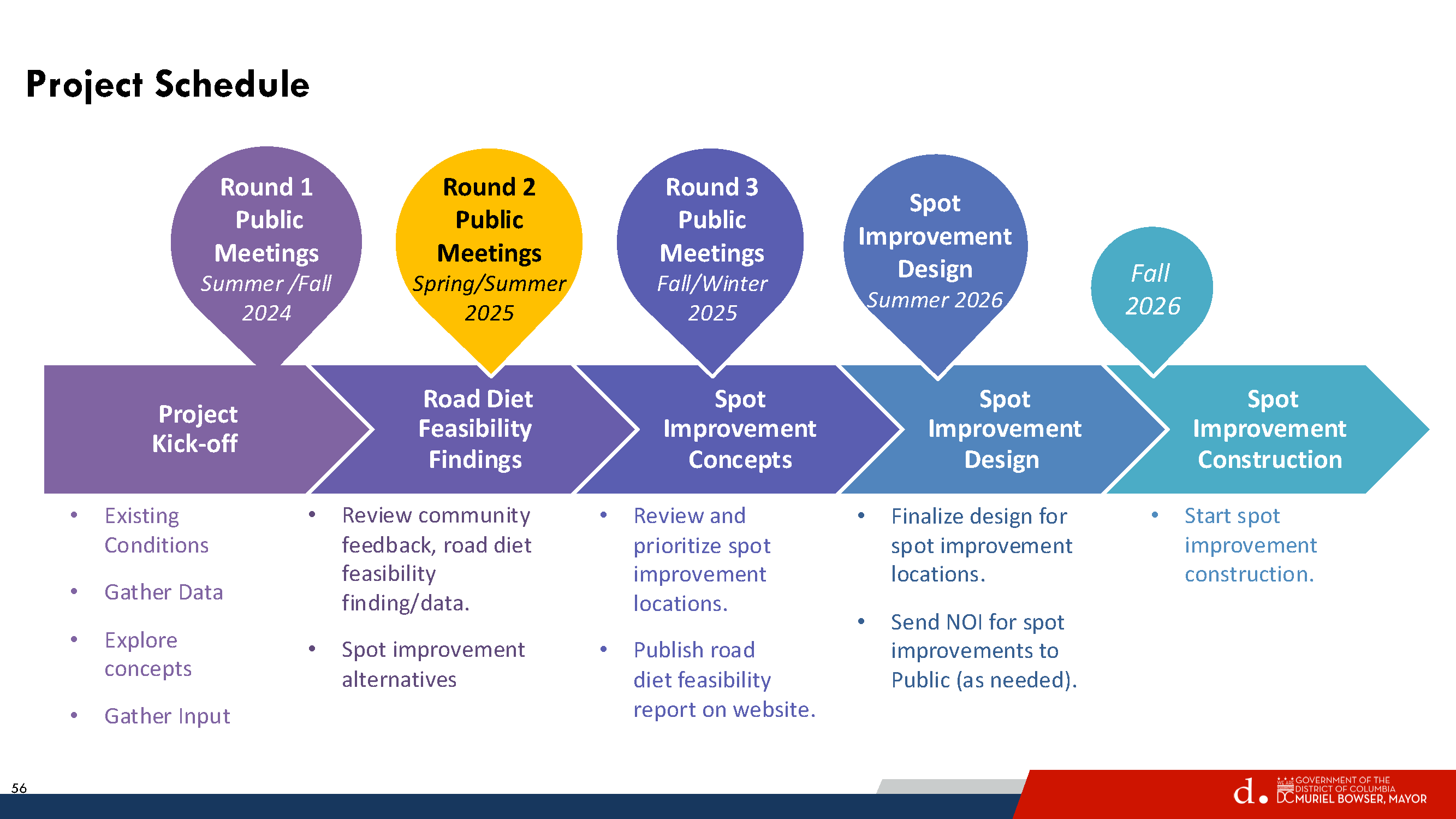
DDOT will have a another meeting to review and prioritize spot improvement locations. Once the locations are selected, DDOT will finalize design and issue Notices of Intent (NOIs) before installing any treatment. DDOT expects to start spot improvement construction in fall 2026.
Remember to complete the DDOT Spot Treatment survey this week.
 Next Stop...Riggs Park