
Guest Post by David Kosub
*** Please note David is only a citizen historian and apologizes for any incidental fake news. He hopes neighbors share these stories and are inspired to write about their community in the new year too.*** [Ed. Note: If you would like to contribute a blog post for Next Stop . . . Riggs Park, please send an email to nextstopriggs@gmail.com]
Welcome to Part 2 of our Lamond-Riggs naming story. As you may recall, we met the Lamonds in Part 1 of the series, learned to make Terra Cotta, and found out about a little ol’ horrific train disaster. With that introduction, let’s meet Riggs.
The President’s Banker
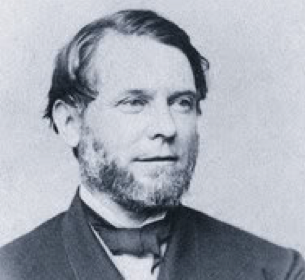
Picture of George Washington Riggs
Born on Independence Day in Georgetown in 1813, George Washington Riggs was definitely a firecracker. A true high-roller 19th century style, Riggs teamed with William Corcoran, of the present-day Dupont gallery fame, in what would become a very lucrative banking empire. Their bank, as a result of a government decision, was the only one allowed to obtain a large chunk of federal depositories in the city, leading to crazy profits. Rolling on all cylinders, they helped finance the Mexican-American War with over $15 million in loans from the federal government, provided over $7 million in gold for the purchase of Alaska, financed the development of the telegraph, provided funds to expand the Capitol, and resourced one of the first expeditions to the South Pole.
Multiple Presidents (including a Confederate one), Cabinet Secretaries, Senators, Generals, suffragettes, Red Cross founders, and many embassies entrusted their treasures with Riggs Bank. Riggs himself retired from the bank in the late 1840s, but his family had a stake in the institution until the early 20th century. In 1904, their new headquarters on Pennsylvania Ave was notable for its “Ladies’ Department,” designed to meet the special needs of women, including Clara Barton and Susan B. Anthony (ooh la la).
Riggs spent much of his time not too far from where you currently sleep. His 197-acre country estate was situated on a high vantage point, with views of the U.S. Capitol (though technically outside the city back then). You may know of this area now as the Armed Forces Retirement Home after the federal government purchased it from the Riggs estate in 1851 for $57,000 (after paying only $3,400 to purchase the site nine years earlier). It was on these grounds in the summer of 1862 where President Lincoln penned the final draft of the Emancipation Proclamation (only a dozen years after enslaved persons may have lived here too). Today, now recognized as a DC historic site and on the National Register of Historic Places, this property has sculptured landscapes, war memorials, and the original Gothic Revival-style cottage which bears the Riggs name.
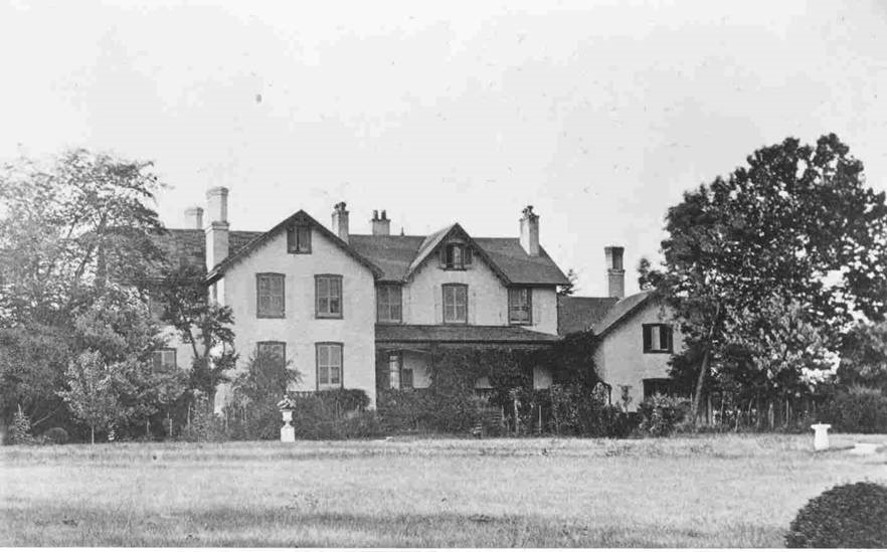
Lincoln Cottage. Source
Because you cannot hide money, Riggs established a second country estate – a new, slightly more modest 140-acre one known for its “fine blooded cattle” in present day Silver Spring. Alas, this one had to be sold too, a mere week after a “skirmish” between Union and Confederate troops that left the nearby vicinity torched and plundered in 1864. Though 300 people died, the Riggs family suffered too, losing “some hay forage,” vegetables, and a valuable ox.” Today, the property serves as a private school for students with learning disabilities.
At the age of 68, Riggs passed away in his Green Hill home—yes, a third country estate, which was 342 acres in Hyattsville and included the only mill still surviving in Prince George’s County. An obituary crooned that Riggs was “remarkable for strength of mind and . . . power to grasp and fathom any subject presented to him . . . and in all his transactions, his judgement prompt, and his conclusions just.” Wow, it’s like reading a biography of yours truly. Not too far from the Lamonds, Riggs can also be found lazing around Rock Creek Cemetery too (section D, Lot 14) – just a 25-minute stroll from the community bearing his name.
Bankers to the Most Important Money in the World – Yours
Now, let’s check back in with Riggs Bank (see these simply amazing commercials here, here, here and the 1980’s jingle here). Lasting over 150 years, with multiple iconic branches in the District, including Georgetown, Dupont, and across from the U.S. Treasury, it kind of fell with a thud. Though not as cool as this sort of Riggs downfall here, the bank’s failure in the early 21st century was just as epic and followed, wait for it . . . a handful of money laundering scandals resulting in the company paying millions in fines and penalties.
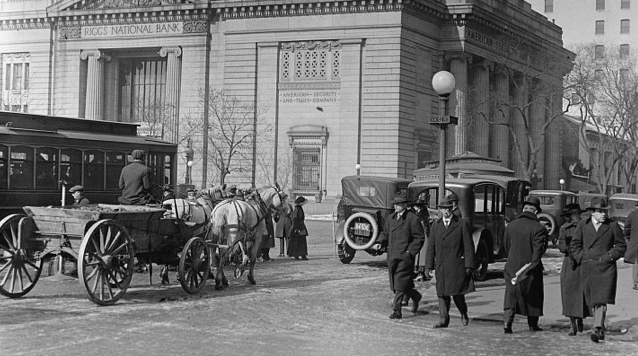
Image of Riggs National Bank ca. 1913-1918. Source
Remember those embassies mentioned earlier, and their treasures too? Well, various employees at Riggs Bank were caught embezzling over $30 million in oil revenues from the Embassy of Equatorial Guinea on behalf of that country’s dictator. One of the employees at the Dupont branch would apparently even walk up the road to the embassy and collect briefcases containing stacks of shrink-wrapped bills. The bank also was connected to yet another dictator, this time with Chile, helping him hide additional millions (see here how the bank tried to make good on this one). Federal reports also noted that the bank “inadequately monitored the destinations and uses of large amounts of cash, often more than $1 million at a time” in over 150 accounts linked to the Saudi Arabian embassy and ambassador (it even got a shout out on Meet The Press). And, of course, the bank was linked to the CIA too, because, why not?
Alternative facts: What If . . .
It is still unclear to me, however, why our neighborhood went from being known as Terra Cotta to Lamond-Riggs (Lamond & Riggs Park neighborhoods collectively) today. I find it a shame because Terra Cotta sounds pretty cool actually. I would like to believe that it goes deeper than just the nature of evolving communities and adjacent streets . . . like maybe the two families knew each other at some point in their life.
Perhaps Riggs issued a loan to Lamond to start the plant, who then reciprocated with a gift of the first clay tile hot out of the oven. Or, maybe Alcena caused an uproar at a citizen’s association meeting over the most hyper-local issue of the day — overgrown trees, unsafe pedestrian crossings at train tracks, silent invocations, and potholes, yes definitely potholes. Perhaps they shared stories over a pint during a Thirsty Third Terra Cotta Thursday too.
Regardless of the reason, we all live here together and have made it the tight, close-knit community it is today. As history happens every second of every day, let’s continue to create it, stroll through it, welcome it, and learn about the hidden mysteries that exist right under our noses.
 Next Stop...Riggs Park