UPDATE at bottom of post
“Will this ugly, spottily developed yet transit-accessible District neighborhood ever be improved?”
That’s the thought posed in the latest Washington Post article about the neighborhood called “Fort Totten site in for major makeover that has community, city support.” The piece, written by practicing architect and University of Maryland architecture professor emeritus Roger K. Lewis, focuses on the current look of the neighborhood. The author appears to write from the position of most people who zip through the neighborhood along the major corridors of Riggs Road NE, South Dakota Avenue NE, New Hampshire Avenue NE, or Eastern Avenue NE, or who get a glimpse of the neighborhood from the metro. From that perspective, the neighborhood appears to be a sea of low-slung red brick dotted with industrial warehouses.
Red brick semi-detached homes dominate the homes closest to Fort Totten metro. Older detached single family ramblers dot the edges around Eastern Avenue and Kennedy Street. Split level semi-detached homes occupy a few side streets. A few recently built four-story detached single family homes can be found off Kennedy Street behind the gas station. A little farther away from the metro are more semi-detached homes giving way to a greater concentration of older detached red brick single family homes. At the furthest edge of the neighborhood are the new Comstock homes, consisting of detached single family homes and townhomes of various shades of brick that complement the older neighborhood homes.

New Comstock Homes
Several older flat roof, boxy red brick apartment buildings dot the neighborhood. The newest apartment build in the neighborhood, Aventine at Fort Totten, received a makeoever last year, going from a muted pale yellow to a brightly colored melange of oranges, greens, and blues, with a bit of brick and stone treatment, and lots of new landscaping.
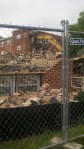
That brings us to the heart of the Washington Post article, the planned Art Place at Fort Totten project. Across the street from the Aventine sits what is left of the Riggs Plaza Apartments, described in the article as “architecturally undistinguished, cookie-cutter apartment buildings.” Five Riggs Plaza apartment buildings were razed last year to make way for the beginning phase of Art Place at Fort Totten, a planned unit development (PUD) being developed by the Cafritz Foundation. The author’s question at the top of the post serves as a launching point from which he can then describe Art Place as a transformative project for the neighborhood that is supported by the community (according to Cafritz representatives).
The article discusses the changes afoot to create more of an urban form and add density to a neighborhood that some describe as a suburb in the city. These changes include the city’s reconfiguration of the South Dakota Avenue and Riggs Road intersection and the city-financed razing of the strip mall that cleared the land on which mixed-use development Fort Totten Square is currently being constructed.
Art Place, which according to the author will see construction begin in the next few months,* is another piece in the creation of a better urban form. The project will be a mixed-use, higher density project in an otherwise relatively low-density neighborhood. The author praises the renderings of the first phase, which will consist of retail, community activity space, and apartments, with some reserved for seniors and residents displaced from the Riggs Plaza apartments, as “an uncompromisingly modern ensemble of street-facing edifices that will be functionally and aesthetically unlike anywhere else in the neighborhood or in nearby Prince George’s County.” The author notes that one corner will feature a triangular shaped building, while the front of the buildings along South Dakota Avenue will avoid the appearance of a single block mass typical of many newer builds in the city. Designs for subsequent phases of the project, which will potentially consist of additional housing and retail, new public library, children’s museum, and office space, are still on the drawing board.
One could quibble about the term revitalization used in reference to this project and an established neighborhood. However, there is no question that if the project includes retail and amenities that the community desires (i.e. not on the level of a Walmart), then the project will indeed be greatly supported by the community.
*According to the article, Cafritz representatives stated construction will begin in a few months. That statement leads me to an aside, which is that the choice to focus on the Cafritz project in particular is an interesting one. Maybe that focus will drum up interest from an anchor so that the project gets financing. We know a bid for a general contractor went out earlier this year in May, with Cafritz representatives stating that one would likely be selected by the end of July.
Updated 8/27/13 with the following aside:
My aside at the end of the post squares with one of the reasons I had a real hesitation about soliciting a Walmart for the Fort Totten Square site. Of course the community will support mixed use development that brings quality retail. One thing the author is correct in noting is that development in the neighborhood is spotty. That is the precisely why I thought bringing in a retailer with Walmart’s reputation was a move that would make getting other development (and actually getting quality ancillary retail in FTS as well) an uphill climb. That’s not to say we won’t eventually get retail and amenities that will meet the needs of many people, just that it’s a task. As we see, the Art Place project right by the metro still features vacant lots, as construction of Fort Totten Square proceeds. Eventually something will go there and undoubtedly there will be those who will say that Walmart was the catalyst for development coming to the neighborhood, forgetting the years the Art Place project was stalled because of Walmart’s pending arrival down the street. I realize there will be plenty who will patronize the Walmart, even community residents, so this is not a point about whether DC residents shop at Walmart. It is a point about the uncertainty of having a Walmart as the first major development in the area. A related point that I might flesh out more in an actual post is that I think some of the issues we are having (and why we have a Walmart coming in the first place) relate to the demographics (real and perceived) of the neighborhood.







 Next Stop...Riggs Park